The complete guide to outdoor porcelain tiles for UK gardens: 20mm paving, slip and frost resistance, porcelain vs stone, indoor-outdoor flow, cost and care.
Outdoor porcelain tiles are structural 20mm-thick porcelain pavers engineered for UK gardens, patios and terraces, offering frost-proof, stain-proof and slip-resistant paving that never needs sealing and comfortably survives cold, wet British winters year after year.
With a water absorption rate below 0.5%, there is almost no water inside the tile to freeze and crack it, which is why porcelain is frost-proof where porous paving fails. Rated R11 or R12 for slip resistance, it grips securely when wet, and because it does not absorb moisture it never soaks up moss, algae or organic staining the way natural stone and concrete do. Perhaps its most desirable quality is continuity: many ranges are made in matching 10mm indoor and 20mm outdoor versions of the same tile, so a single floor can run from kitchen to patio without a visible break.
What this guide covers
Outdoor porcelain has quietly become the paving of choice for well-designed UK gardens, and this guide explains exactly why. Our design team specifies effect-porcelain across indoor and outdoor projects every week, so below we cover what outdoor porcelain actually is and why 20mm matters, how it beats natural stone and concrete outdoors, the uninterrupted indoor-outdoor flow that clients love most, the three installation methods and when each suits, the specific realities of UK weather, honest cost bands, how to choose, how to maintain it, and the mistakes to avoid. Where a question deserves more depth, we link to our focused articles.
What are outdoor porcelain tiles?
Outdoor porcelain tiles are not simply thicker versions of the tiles you use indoors: they are a distinct, engineered paving product. Four properties define them.
They are 20mm thick and structural. Where indoor porcelain is typically 9-10mm, outdoor porcelain is 20mm for the load-bearing strength a paver needs. That thickness lets it span, resist point loads (a table leg, a heel, a dropped pot) and, in some installation methods, sit on pedestals with nothing but air beneath.
They are frost-proof. This follows directly from porcelain's defining property: a water absorption rate below 0.5%. Frost damage happens when water soaks into paving, freezes, expands and splits the material. Because porcelain barely absorbs any water, there is almost nothing to freeze, so it survives UK frost-thaw cycles year after year without cracking or spalling.
They are slip-resistant. Outdoor porcelain is manufactured with a textured surface rated R11 or R12 (the higher end of the slip scale) so it stays secure underfoot even when wet with rain. That grip is built into the surface, not applied as a coating.
They never need sealing. The colour and finish are fired into the tile, so there are no open pores for water, moss or stains to enter. You never seal outdoor porcelain on installation and never re-seal it: a stark contrast to natural stone.
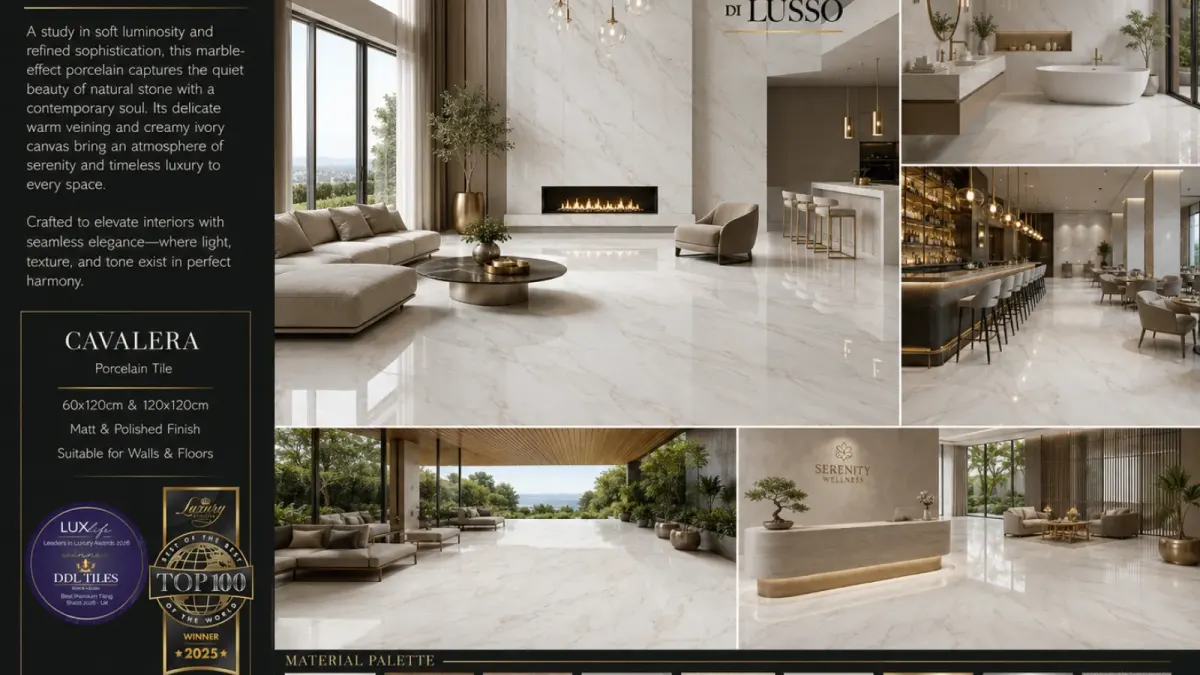
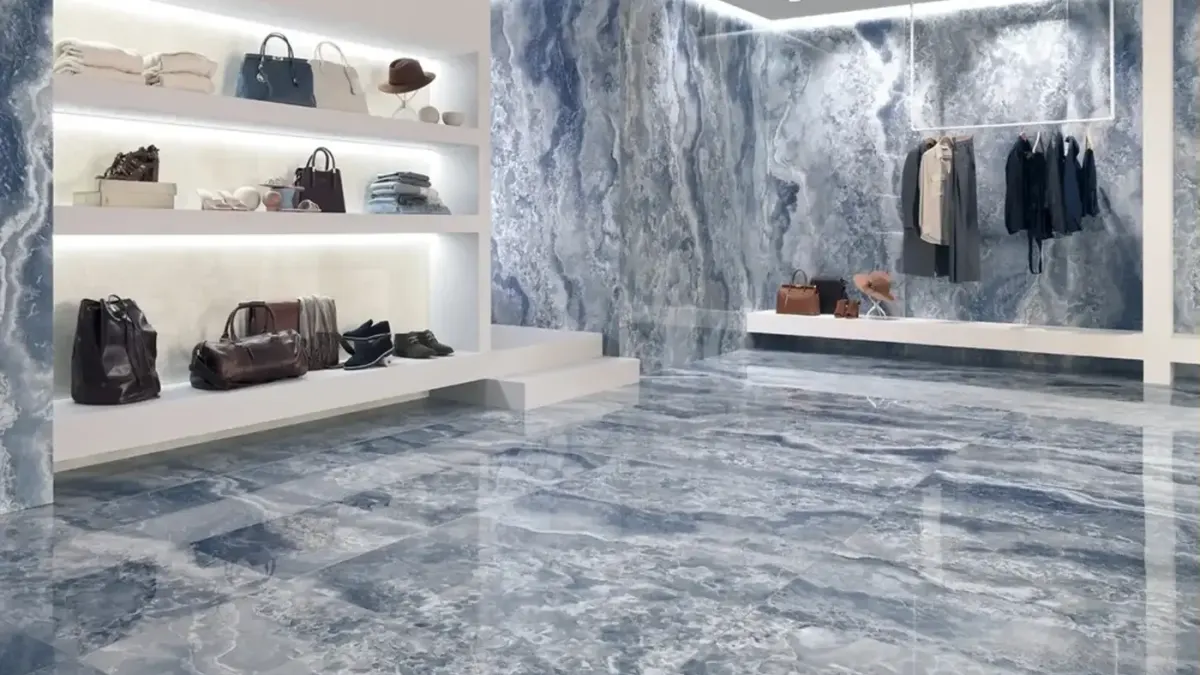
The finishes reproduce natural stone, concrete, wood and even marble effects convincingly, so you get the appearance you want with the performance of engineered porcelain.
Why porcelain beats natural stone and concrete outdoors
Clients often start with sandstone, limestone or concrete slabs in mind, so this is the comparison our team walks through. Outdoors, in the British climate, porcelain wins on almost every practical measure.
| Property | Natural stone paving | Concrete paving | Outdoor porcelain |
|---|---|---|---|
| Water absorption | High (porous) | Moderate-high | Below 0.5% |
| Frost resistance | Variable, can spall | Variable | Frost-proof |
| Sealing required | Yes, on install + repeat | Often | Never |
| Moss / algae | Soaks in, grows readily | Grows readily | Does not soak in, wipes off |
| Staining | Stains readily | Stains | Stain-proof |
| Slip when wet | Variable | Variable | R11 / R12 rated |
| Colour fade | Can fade / weather | Can fade | Colour-stable |
| Maintenance | High | Moderate | Minimal |
| Indoor-outdoor match | No | No | Yes (matching indoor tile) |
The three differences that matter most in practice:
No sealing, ever. Natural stone is porous and must be sealed on installation and re-sealed periodically to resist staining and weathering. Porcelain removes that job entirely and permanently.
It doesn't soak up moss and algae. The green film that colonises a stone or concrete patio grows because the surface absorbs moisture and organic matter and holds it. Porcelain doesn't absorb, so moss and algae have nothing to root into: a porcelain patio stays cleaner and washes down with water alone.
It is stain-proof and colour-stable. Wine, barbecue grease, leaf tannins and pot rings that permanently mark porous paving simply sit on the surface of porcelain and wipe away, and the fired colour does not fade in UV the way some natural stone weathers. For stone lovers who want the look without the upkeep, our stone-effect tiles deliver exactly that.
The uninterrupted indoor-outdoor flow
If there is one design move that defines contemporary UK homes, it is the unbroken flow from kitchen or living space out onto the terrace, and outdoor porcelain is what makes it possible.
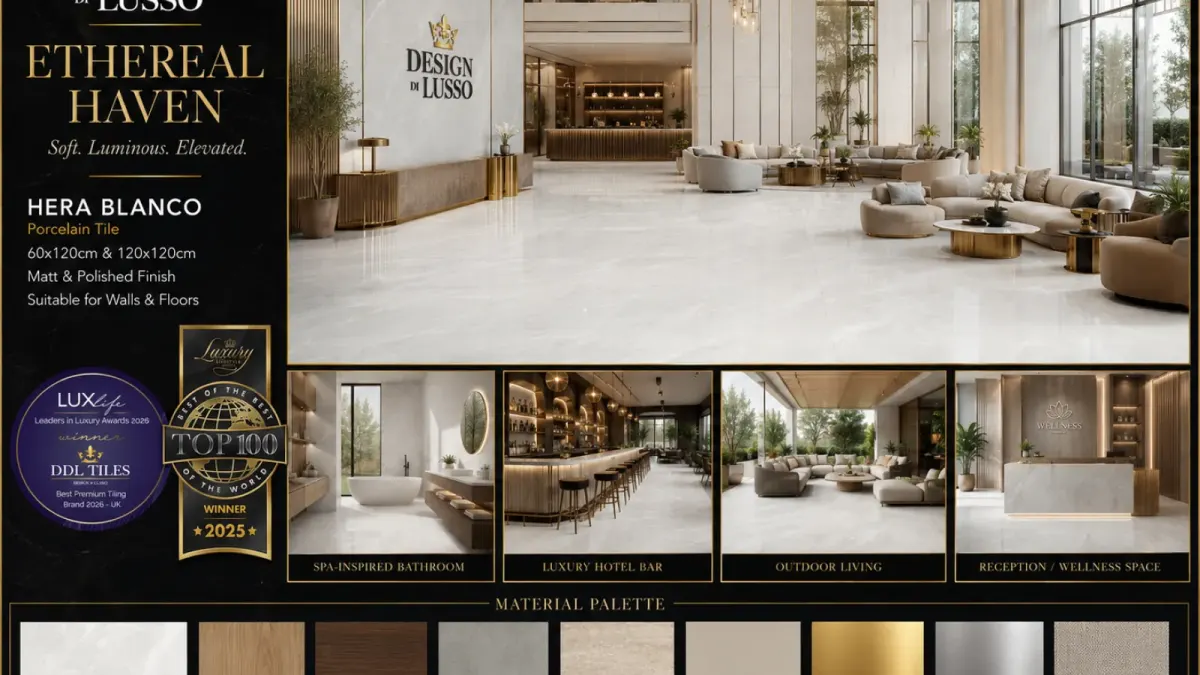
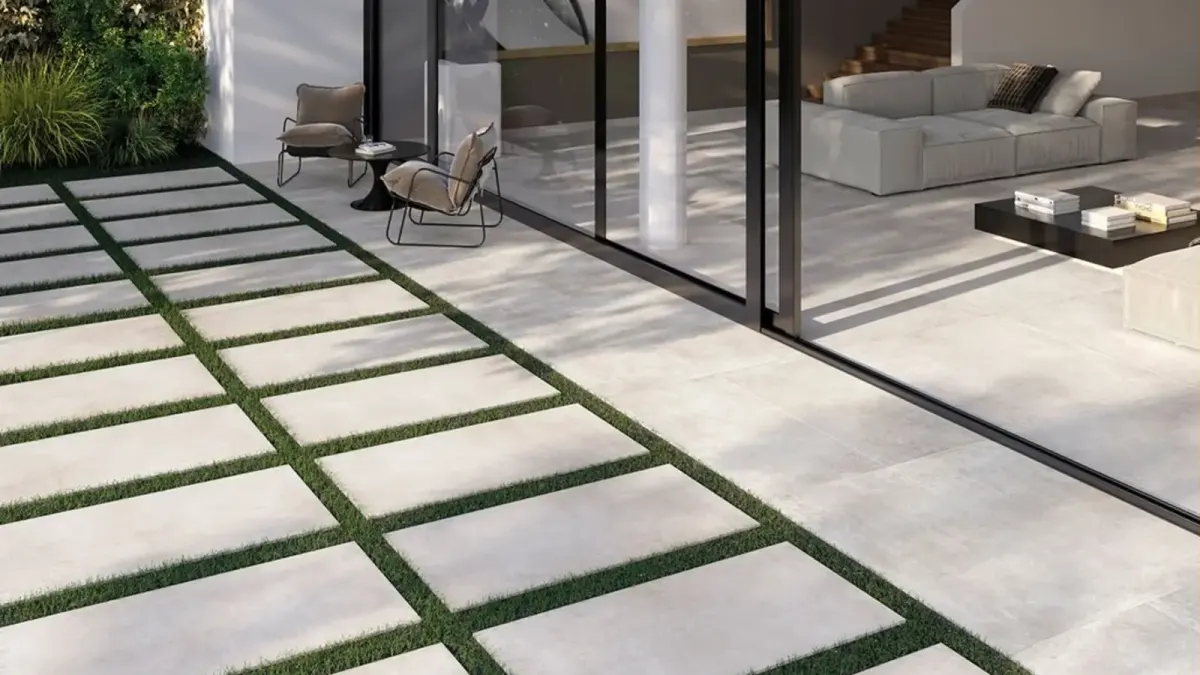
The principle is simple and specific to porcelain: many ranges are produced in matching 10mm indoor and 20mm outdoor versions of the same tile, identical in colour, pattern and finish. You lay the 10mm indoors and the 20mm outdoors, and because both faces are the same, the floor reads as one continuous surface running from inside to out. With large-format tiles and level thresholds (the indoor floor and outdoor patio set to the same finished height across a flush or minimally-tracked sliding door) the eye simply doesn't register a boundary. The garden becomes a visual extension of the room, and the room borrows the light and space of the garden.
This is impossible with natural stone or concrete, which cannot be matched to an indoor floor, and it is the single reason many of our clients choose porcelain for both surfaces. Pairing this with large-format tiles amplifies the effect, because fewer joints across both spaces heightens the sense of one unbroken plane.
If you are approaching it from the other direction (already have outdoor porcelain and wonder whether the same tile works inside), our guide on whether you can use outdoor porcelain tiles indoors covers the practicalities.
How outdoor porcelain is installed: three methods
Outdoor porcelain can be laid three ways, and the right choice depends on the base, the use and whether you want a permanent or liftable surface. This is skilled groundwork: the paving is only as good as what sits beneath it.
Full mortar bed (bonded)
The traditional, permanent method: the 20mm tiles are bedded on a full mortar bed over a concrete or compacted base, using an outdoor-grade flexible adhesive with full coverage beneath each tile (voids are the enemy: water collects and freezes in them). This gives the most solid, immovable finish and suits patios, paths and any area taking heavy or point loads. A slight fall (around 1:80) is built in so rainwater runs off.
Grid / gravel
A simpler method for lighter-use areas: the tiles sit on a compacted, free-draining base of sub-base and grit, often with a fixing grid to keep spacing consistent. It is quicker and allows drainage between joints, suiting garden paths and secondary terraces where a full mortar bed isn't warranted.
Pedestal (raised)
For roof terraces, balconies and areas over a waterproof membrane, tiles sit on adjustable pedestals at each corner, raised above the surface with air beneath. This creates a perfectly level deck regardless of the fall below, hides drainage and services, allows access to the membrane, and lets rainwater drain straight through the open joints. The 20mm structural thickness is what makes pedestal installation possible: a thinner tile would crack under load spanning between supports.
Whichever method, the groundwork and drainage are as important as the tile. Poor base preparation, not the porcelain, is behind almost every outdoor paving failure.
UK weather: how outdoor porcelain actually performs
Britain tests paving in specific ways: repeated frost-thaw, near-constant damp, low winter sun, algae-friendly shade and heavy rain. Outdoor porcelain is essentially designed for exactly these conditions.
Frost. The below-0.5% absorption means frost-thaw cycles have almost no water to work on, so porcelain doesn't spall or crack over UK winters the way some sandstone and concrete can.
Rain and slip. The R11/R12 rating is a wet rating, tested for grip with water present, so a porcelain patio stays secure through British rain rather than becoming a skating rink.
Damp and shade. In the shaded, perpetually-damp corners where stone patios go green, porcelain's non-absorbency denies moss and algae the moisture and organic matter they need to establish, so the green film that does settle on the surface washes straight off.
UV and colour. The fired colour is stable, so a porcelain terrace does not bleach or weather patchily in summer sun the way some natural materials do.
The one genuine UK-specific caution is the same as for any hard paving: surface water and ice. Good installation builds in falls and drainage so water runs off, and while porcelain's texture grips well, no paving is immune to a hard frost forming a film of ice, which is a groundwork and drainage point, not a fault of the material.
How much does outdoor porcelain cost?
Outdoor porcelain sits in the premium paving bracket, and, as with all quality paving, the groundwork and installation are a significant part of the total. Treat the figures below as indicative UK supply bands per square metre, before installation.
| Product / type | Indicative supply band (per m²) | Notes |
|---|---|---|
| 20mm outdoor porcelain, standard ranges | £ premium band | Stone and concrete effects, common sizes |
| 20mm large-format outdoor porcelain | £ upper-premium band | Fewer joints, continuous look |
| Matching 10mm indoor + 20mm outdoor set | £ premium band each | Priced per surface, coordinated look |
| Coping, steps and matching trims | £ per-piece premium | Specified alongside the paving |
Two points to weigh against the headline rate. First, installation and groundwork are where the durability comes from: a properly prepared base, correct falls, full-coverage bedding and drainage are essential and worth budgeting for; poor groundwork undermines even the best tile. Second, think in lifetime terms: porcelain never needs sealing, resists stains and frost, doesn't fade and washes clean with water, so its running cost is close to nothing. Over the life of a garden, that makes it a genuinely sound investment against paving that needs sealing, jet-washing and eventual replacement. Our team can price your specific project once we know the area, range and installation method.
How to choose outdoor porcelain tiles
The right specification is a short sequence of decisions, best made in this order.
- Confirm it's genuine 20mm outdoor porcelain. Only structural 20mm paving is engineered for external ground use. Don't lay 10mm indoor tiles outside.
- Check the slip rating. Look for R11 or R12 for garden paving; it should be stated for the specific finish.
- Choose the effect. Stone, concrete, wood or marble effects: pick what suits the house and garden style.
- Decide on indoor-outdoor matching. If you want uninterrupted flow, choose a range with a matching 10mm indoor version and plan the thresholds early.
- Pick the format. Large format means fewer joints and a calmer terrace; standard formats suit paths and smaller areas.
- Match the installation method to the site. Mortar bed for solid patios, grid/gravel for lighter paths, pedestals for roof terraces and balconies.
- Specify coping and steps together. Matching trims, steps and pool/edge pieces finish the scheme properly.
- See it outdoors, wet and dry. Colours and textures read differently in daylight and rain than under showroom spots.
Maintaining outdoor porcelain
The maintenance story is the easiest part, which is much of the appeal. Because porcelain doesn't absorb, there is no sealing, no annual treatment and no feeding the stone. For routine care, sweep off debris and wash down with water and a mild detergent; a stiff brush lifts any surface film. A pressure washer can be used but isn't usually necessary and should be kept off the joints at close range. Because moss and algae can't root into the surface, the green growth that plagues stone patios simply doesn't establish, and what settles on top rinses away. Grout or jointing compound is the only element that benefits from occasional attention. In practical terms, an outdoor porcelain terrace looks as good in year ten as in year one with nothing more than a wash-down.
Common outdoor porcelain mistakes
The errors we most often see, and correct, come down to specification and groundwork, not the tile itself.
- Laying 10mm indoor tiles outside. Indoor porcelain isn't structural and isn't frost-rated for ground use. Outdoors needs genuine 20mm outdoor porcelain.
- Skimping on the base and drainage. The commonest failure. No falls, a soft or uneven base, or voids under the tiles lead to ponding, movement and frost damage. Groundwork is most of the job.
- Ignoring the slip rating. Choosing a smooth finish for a wet British garden. Specify R11 or R12.
- Leaving voids under mortar-bedded tiles. Water collects and freezes in hollow spots. Full-coverage bedding is essential.
- Forgetting the indoor-outdoor thresholds. Wanting an uninterrupted flow but not planning matching tiles and level thresholds early enough to achieve it.
- Overlooking access and edging. No plan for steps, coping or how the paving meets lawn, beds and drainage.
- Treating it like a DIY patio. Porcelain is hard to cut and demands correct bedding and falls; skilled installation protects the whole investment.
Frequently asked questions
Are outdoor porcelain tiles frost-proof?
Yes. Outdoor porcelain has a water absorption rate below 0.5%, so there is almost no water inside the tile to freeze, expand and crack it. This makes it genuinely frost-proof through UK winters, unlike porous natural stone and concrete, which can absorb water, freeze and spall over repeated frost-thaw cycles. It is one of porcelain's biggest advantages outdoors.
Do outdoor porcelain tiles get slippery when wet?
No, provided you use genuine outdoor paving. Outdoor porcelain is manufactured with a textured surface rated R11 or R12 for slip resistance (the higher end of the scale) and that rating is tested wet, so it grips securely in rain. The texture is built into the tile, not a coating, so it doesn't wear off. Always confirm the R-rating for garden use.
Can you use the same tile indoors and outdoors?
Yes, and it's one of porcelain's best features. Many ranges are made in matching 10mm indoor and 20mm outdoor versions of the same colour and finish. Laid with level thresholds, they create a floor that runs from kitchen to patio as one continuous surface: impossible with natural stone or concrete, which can't be matched to an indoor tile.
Do outdoor porcelain tiles need sealing?
Never. The colour and finish are fired into the porcelain, so there are no open pores for water or stains to enter. You don't seal it on installation and you never re-seal it. This is a major difference from natural stone, which is porous and must be sealed on install and re-sealed periodically for its whole life to resist staining and weathering.
How thick should outdoor porcelain tiles be?
20mm. Outdoor porcelain is made structural at 20mm thick so it can bear loads, resist point pressure and, where required, sit on pedestals with air beneath. Indoor porcelain is typically 9-10mm and is not engineered for external ground use. If a tile is being sold for a patio or garden, confirm it is genuine 20mm outdoor porcelain.
Does moss and algae grow on porcelain paving?
Far less than on stone or concrete. Moss and algae need moisture and organic matter to root into, and because porcelain doesn't absorb water they have nothing to establish in. Any green film settles on the surface rather than growing into it, so it washes straight off with water. This is why a porcelain patio stays visibly cleaner than a porous one with almost no effort.
How is outdoor porcelain installed?
Three ways. A full mortar bed over a concrete or compacted base gives a permanent, solid patio. A grid or gravel base suits lighter-use paths and allows drainage. Adjustable pedestals raise the tiles on supports for roof terraces and balconies over a membrane. All three depend on a well-prepared base with correct falls for drainage: the groundwork matters as much as the tile.
Is outdoor porcelain worth the cost?
For most gardens, yes. Outdoor porcelain sits in the premium paving bracket and needs skilled installation, but it never needs sealing, resists frost and stains, doesn't fade, and washes clean with water alone. Over the life of a garden it avoids the sealing, jet-washing and eventual replacement that porous paving demands, making its total cost of ownership genuinely low.
Give your garden a surface that lasts
Outdoor porcelain has changed what a UK garden floor can be: frost-proof, stain-proof, slip-resistant paving that never needs sealing, refuses moss and algae, and, uniquely, flows without a break from your kitchen out onto the terrace on the same visual plane. The material does the hard work; the decisions that matter are choosing genuine 20mm paving with the right slip rating and finish, planning the indoor-outdoor thresholds early, and investing in proper groundwork and installation. Get those right and you have a garden surface that looks as good in a decade as on the day it was laid, with nothing more than a wash-down in between.
See outdoor porcelain paving at our Watford showroom
Outdoor porcelain reads differently outside than on a screen: the texture, the way finishes handle wet and dry, and how a 20mm tile pairs with its matching indoor version only become clear when you see them at scale. Visit our 7,000 sq ft showroom in Watford to explore outdoor porcelain ranges, compare stone, concrete and wood effects, see matching indoor-outdoor sets, and plan your garden or terrace with our award-winning design team. As effect-porcelain specialists, we will help you specify paving that performs beautifully through every British season.
Book your free consultation at our Watford showroom →
Design Di Lusso (DDL Tiles), Watford, Luxury Lifestyle Awards, Top 100 Best of the Best 2025. Explore our outdoor porcelain tiles, large-format tiles and stone-effect tiles, and read whether you can use outdoor porcelain tiles indoors.