The complete UK guide to luxury bathroom design in 2026: anatomy, the design process, cost bands from £10k-£25k+, underfloor heating, mistakes to avoid.
Luxury bathroom design is the discipline of composing a bathroom as a single, considered scheme, where materials, tiling, lighting, sanitaryware, brassware, storage and proportion are specified together rather than bought piecemeal, so the finished room feels calm, cohesive and expensive in a way no individual fitting could achieve alone.
A genuinely luxury bathroom is not simply a standard bathroom with a costly bath dropped into it; it is the result of decisions made in the right order, junctions resolved before installation, and restraint applied everywhere. The hallmarks are large-format tiling with minimal grout lines, layered lighting, a statement bath or walk-in shower, quality brassware, integrated storage and careful symmetry. In the UK in 2026, a luxury bathroom typically costs between £10,000 and £25,000 or more, and the difference between a good result and a disappointing one is almost always design, not spend. That is the case this guide makes.
That is the honest, direct answer. But the more useful question is "what actually makes a bathroom read as luxury, and how do you design one properly rather than assembling expensive parts and hoping?" Luxury bathroom design is Design Di Lusso's core discipline, and in this guide our design team walks through it exactly as we do for clients in our Watford showroom: the anatomy of a luxury bathroom, the design process stage by stage, honest 2026 cost bands and what drives them, where design adds the most value, underfloor heating, small versus large rooms, the mistakes we see most often, and why a showroom and a designer change the outcome.
What this guide covers
This is a comprehensive, practical guide to designing a luxury bathroom in the UK. We start with the anatomy: the seven elements that separate a luxury bathroom from an ordinary one, then walk through the four-stage design process from brief to installation. We give honest 2026 cost bands from £10,000 to £25,000 and beyond, explain exactly what drives that figure, and show where your investment earns the most. We cover underfloor heating, the differences between designing small and large luxury bathrooms, the common and costly mistakes to avoid, and why specifying through a designer and a proper showroom is the single decision that most reliably raises the finished standard. Throughout, we link down to our deeper guides on luxury bathroom cost, making a small bathroom look luxurious and underfloor heating under tiles.
What is the anatomy of a luxury bathroom?
Ask most people what makes a bathroom luxurious and they'll point at a single object: a freestanding bath, a rainfall shower, a gold tap. In reality, luxury lives in the relationships between elements, not the elements themselves. A luxury bathroom is a system of around seven components, each specified with the others in mind. Get the system right and even a restrained scheme feels expensive; get it wrong and no amount of costly fittings rescues it.
Materials and surfaces
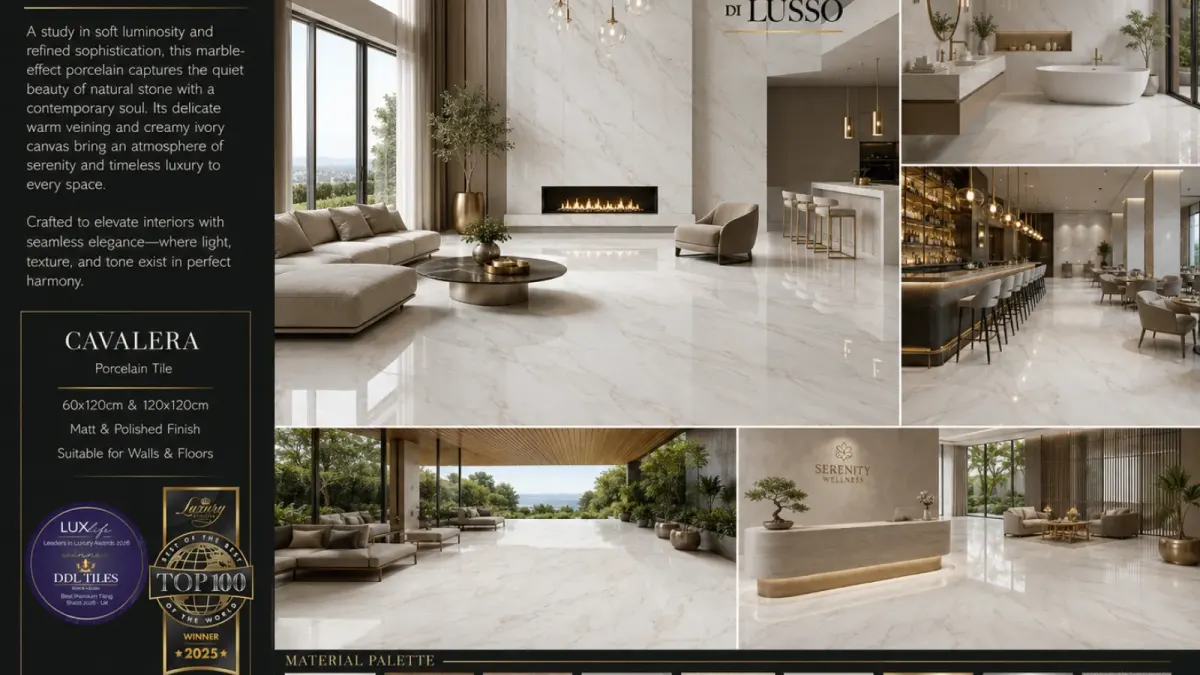
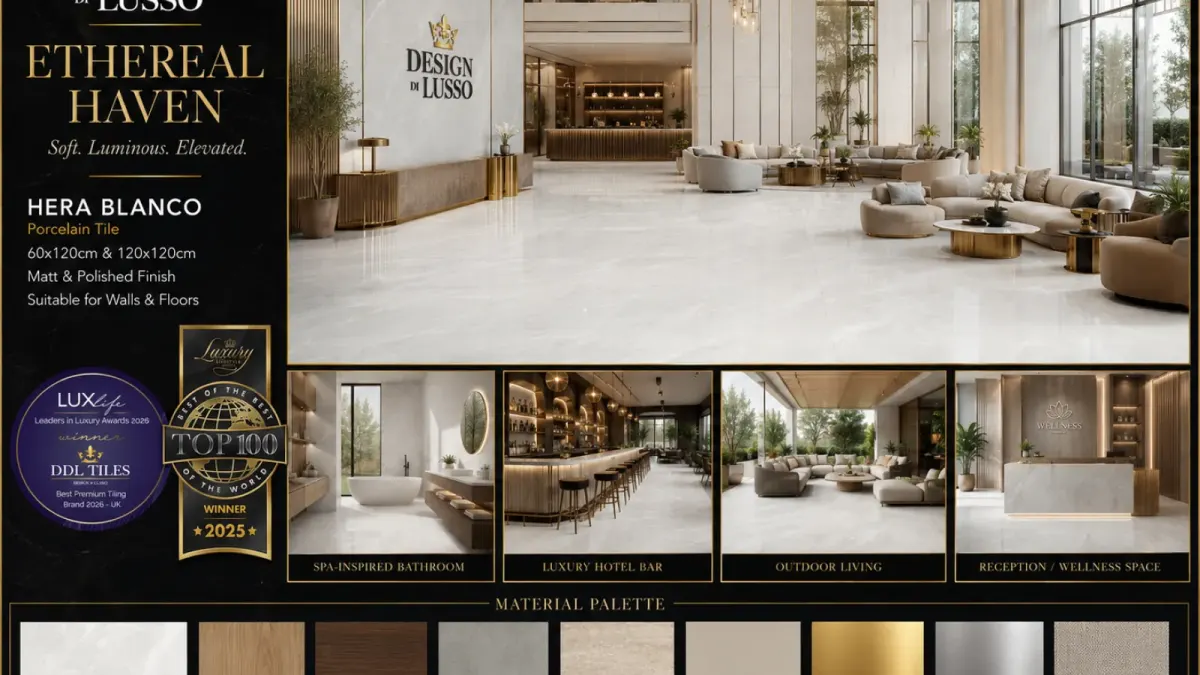
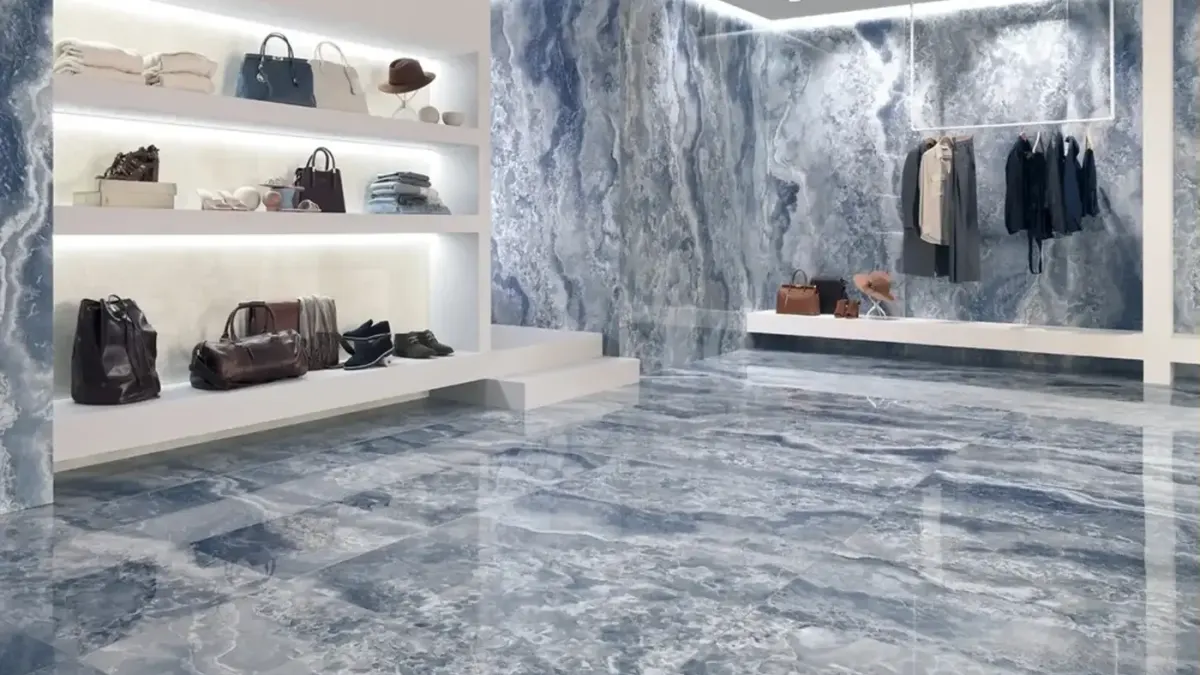
Material is the foundation, and it's where a scheme either reads as considered or as catalogue. Luxury bathrooms favour a disciplined, tonal palette: a hero surface carried across walls and floor, warmed with timber or stone accents and metal in the brassware. Effect porcelain does most of the heavy lifting here, because it delivers the look of marble, stone, concrete or timber with none of the sealing, etching or fragility of the natural material. A well-chosen marble-effect tile run large-format across a wall behind the bath, with thin tonal grout, is often the single most luxurious decision in the whole room. The principle is restraint: one confident material, beautifully specified, beats five competing finishes every time.
Large-format tiling
If there is one specification choice that separates a designer bathroom from an ordinary one, it is large-format tiling. Natural stone comes in continuous slabs, so the fewer grout lines you have, the more the surface reads as luxurious, uninterrupted material. Large-format rectified porcelain (commonly 600×1200mm, 1200×2400mm and larger) covers walls and floors with a fraction of the joints of standard tiles, and on vein-matched ranges the pattern flows across the joints like a book-matched slab. Fewer grout lines also mean fewer places for limescale to gather, so the room stays cleaner. The trade-off is weight and the need for a flat substrate and skilled installation, which is precisely why large-format is not a surface to cut corners on.
Considered lighting
Lighting is the most under-specified element in British bathrooms and the one that most transforms a room. A luxury bathroom uses layered lighting: ambient light for the overall room, task light at the mirror and vanity where you actually need it, and accent light (recessed strips, niche lighting, a backlit mirror) to add depth and drama. A single central downlight flattens everything; layered, dimmable lighting on separate circuits lets the same room shift from bright and functional in the morning to soft and spa-like at night. Warm colour temperatures (around 2700-3000K) flatter both skin and stone. Lighting must be designed at specification stage, because it dictates wiring and ceiling work that is expensive to change later.
The statement bath or walk-in shower
Every luxury bathroom needs one clear focal point, and it is usually either a freestanding bath or a generous walk-in shower, rarely a compromise version of both crammed in. A freestanding bath positioned deliberately (centred on a window, framed by a feature wall, given breathing space around it) reads as luxury precisely because it is given room. A walk-in or wet-room shower with a large-format tiled surround, a slim linear drain and frameless glass reads as spa. The mistake is trying to include everything; the luxury move is choosing the hero and giving it the space to perform.
Brassware and metalwork
Brassware is the jewellery of the bathroom: small in area, huge in effect. Quality taps, shower controls, handles and accessories in a consistent, deliberate finish tie the whole scheme together. The finish should relate to the materials: brushed brass and warm gold flatter Calacatta and warm-toned stone; chrome, brushed steel and matt black suit grey and monochrome schemes. Consistency matters more than cost here: mismatched metals across taps, towel rails and hinges quietly cheapen an otherwise expensive room. Specify one metal story and hold it across every fitting, visible and hidden.
Storage and integration
Nothing undermines luxury faster than clutter, so storage is designed in, not added on. Integrated vanity units, recessed shower niches, concealed cisterns, mirror cabinets and fitted joinery keep surfaces clear and lines clean. The luxury feeling comes from calm, uninterrupted planes: a wall of tile broken only by a floating vanity and a framed mirror, with everything else tucked away. Bespoke or made-to-measure joinery, colour-matched to the scheme, is a hallmark of a high-end bathroom precisely because it makes the room feel resolved rather than assembled.
Symmetry and proportion
Finally, the quality that people feel but rarely name: proportion. Luxury bathrooms are laid out on deliberate lines: a vanity centred under a mirror centred under a light, tiles set out so cut tiles fall in discreet places, niches aligned with grout joints, fittings spaced with even margins. This invisible discipline is what makes a room feel calm and expensive. It cannot be bought; it has to be designed. Setting-out drawings that resolve every junction before a single tile is cut are the difference between a room that feels precise and one that feels almost right.
How does the luxury bathroom design process work?
A luxury bathroom is designed in four stages, in order. Skipping or rushing any of them is the single most common cause of disappointing results, because decisions made out of sequence tend to cascade into compromises. Here is the process our design team follows.
1. Brief
Everything starts with a proper brief. Who uses the room and how, what feeling you want (spa-calm, hotel-glamour, gallery-clean), what you love and loathe about your current bathroom, whether it's a family bathroom or an indulgent ensuite, and the realistic cost band. A good brief also captures the practical constraints (window positions, soil-pipe location, ceiling height, whether walls can move) because these shape what's possible. The brief is where honesty saves money: naming the cost band up front lets us design to it, rather than designing a scheme you then have to dismantle.
2. Concept
Next comes the concept: the overall look and feel, the material palette, the layout, the position of the hero fitting, the lighting mood. This is where samples come out, where a marble-effect and a timber and a metal are placed side by side, and where the room is arranged on paper (and increasingly in 3D visuals) before anything is bought. The concept stage is deliberately flexible: it's far easier and less costly to move a bath on a plan than in a fitted room. A strong concept locks the feeling of the room so that every later decision has something to answer to.
3. Specification
Specification is where luxury is actually decided, and it's the stage most DIY and low-end projects skip. Here every element is fixed: exact tile ranges, sizes and finishes; setting-out drawings showing where each tile falls and where cuts land; brassware and sanitaryware models; lighting positions and circuits; the location of every niche, drain, valve and waste; grout colours; and the sequence of trades. A complete specification is what lets an installer build the room precisely as designed, with junctions resolved in advance. Rooms that go wrong almost always went wrong at this stage: decisions left to be made "on site" become compromises made under time pressure.
4. Installation
Finally, installation, and even a perfect specification depends on skilled fitting to realise it. Large-format tiling, wet-room formation, precise setting-out and neat brassware installation all demand experienced trades and a flat, properly prepared substrate. Sequencing matters: first fix, tanking, tiling, second fix and finishing each in the right order. This is not the stage to economise, because it's where the design either becomes real or falls apart at the joints. The best-specified bathroom in the world still needs a fitter who can cut porcelain cleanly and set out a wall dead level.
How much does a luxury bathroom cost in the UK in 2026?
Let's be direct, because vague answers help no one: a luxury bathroom in the UK in 2026 typically costs between £10,000 and £25,000, and bespoke projects run well beyond that. The figure is driven far more by specification and complexity than by floor area. A small ensuite finished to a bespoke standard can cost more than a large family bathroom finished simply. What moves the number is the level of the tiles, brassware and sanitaryware, whether the layout changes (moving soil pipes, forming a wet room, taking down walls), how much underfloor heating and lighting the room needs, how much bespoke joinery is involved, and the standard of installation throughout.
To make the bands concrete, here is how we describe the three levels of luxury bathroom we specify, and what each realistically includes. These are honest premium bands, not quotes; every project is priced on its own drawings.
| Level | Typical cost band (2026) | What it includes | Best for |
|---|---|---|---|
| Considered | £10,000-£15,000 | Existing layout retained; quality effect-porcelain tiling; a strong hero fitting (freestanding bath or walk-in shower); coordinated mid-to-premium brassware; layered lighting; integrated storage; skilled installation | A high-quality, cohesive room without structural change |
| Premium | £15,000-£25,000 | Some layout change (relocated fittings, wet-room formation); large-format and possibly vein-matched tiling; premium brassware and sanitaryware throughout; underfloor heating; fuller lighting design; some bespoke joinery | A designed, cohesive bathroom with proper spatial planning |
| Bespoke | £25,000+ | Full redesign, structural changes, book-matched or feature stone-effect walls, fully bespoke joinery, top-tier brassware and sanitaryware, complete lighting scheme, specialist wet-room and glazing work | A signature bathroom where every junction is resolved to the highest standard |
The single most useful thing you can do is decide which band you're in early, because it changes every subsequent decision. For a full breakdown of what sits behind these figures, including how installation, layout changes and specification each move the total, see our dedicated guide on how much a luxury bathroom costs in the UK. The headline to hold onto: it is far better to design one band well than to spread a larger sum thinly across a room that lacks a coherent scheme.
What actually drives the cost
Four factors move a bathroom's cost more than anything else. Layout change is the big one: leaving fittings where they are is inexpensive, while relocating a soil pipe or forming a wet room adds structural and waterproofing work. Specification level (the grade of tiles, brassware and sanitaryware) sets the material cost and scales across the whole room. Installation standard is non-negotiable in luxury work; skilled tiling and wet-room formation cost more precisely because they deliver the finished, considered result. And bespoke elements, such as made-to-measure joinery, feature stone-effect walls and specialist glazing, carry the top-end cost because they're individually made. Understand these four levers and you can steer the spend deliberately rather than watch it drift.
Where does design add the most value in a luxury bathroom?
Every project's spend is finite, so the useful question isn't "what's most expensive?" but "where does design return the most feeling per pound?" In our experience, the answer is consistent. Setting-out and tiling return the most: large-format tiles with resolved junctions and thin tonal grout transform how the whole room reads, and the cost is mostly in the design discipline and skilled fitting rather than the tile itself. Lighting is the second highest-return investment, because layered, dimmable light changes the room's entire mood for a modest material cost. The hero fitting, one well-placed bath or one generous shower given proper space, earns more than two crammed-in compromises. And storage integration returns value by keeping the room calm and clutter-free. By contrast, spending heavily on multiple statement fittings while neglecting setting-out, lighting and storage is the classic way to spend a lot and feel little. Design is the multiplier; it makes every pound of material read as more.
Is underfloor heating worth it in a luxury bathroom?
Almost always. Under tiles, it's one of the highest-value upgrades available. Porcelain and stone are excellent conductors, so they take up and radiate heat efficiently, warming the whole floor and the room evenly rather than from a single hot radiator. In a luxury bathroom the benefit is twofold: comfort (warm floors underfoot, no cold tile shock) and design freedom, because underfloor heating removes the wall radiator entirely, freeing a wall for tiling, storage or a towel-warmer chosen for looks rather than heat output. It also keeps the room feeling dry and fresh, which matters in a tiled space.
There are two systems: electric (a mat or cable under the tile, ideal for retrofits and single rooms) and wet or hydronic (pipes run from the heating system, more efficient for larger areas and new builds). The right choice depends on the room and the wider project. Underfloor heating must be specified early, because it sits within the floor build-up and affects levels and the tiling sequence. It pairs especially well with large-format porcelain, which conducts heat evenly across its surface. For the full picture on systems, efficiency and whether it's right for your project, read our guide on whether underfloor heating is worth it under tiles.
How is designing a small luxury bathroom different from a large one?
Luxury is not a function of size. Some of the most beautiful bathrooms we design are compact ensembles, and some of the least successful are large rooms filled indecisively. But small and large rooms reward different strategies, and confusing the two is a common error.
In a small luxury bathroom, the moves are about visual continuity and light. Run large-format tiling floor-to-ceiling and, where you can, carry the same tile across the floor to blur the room's boundaries and make it read larger. Favour a walk-in shower over a bath if space is tight, choose a floating vanity to expose floor and create a sense of space, use a large mirror and layered lighting to add depth, and keep the palette tonal and calm. Restraint is everything: one confident material and a clean, uncluttered plane make a small room feel considered and generous. If space is your constraint, our full playbook for compact rooms, how to make a small bathroom look luxurious, is the single most useful read.
In a large luxury bathroom, the challenge flips: the risk is not cramming but sprawl. Big rooms need deliberate zoning, with a bathing zone, a shower zone and a vanity zone arranged on strong axes so the space feels composed rather than empty. This is where a freestanding bath given real breathing room, twin vanities in perfect symmetry, and a generous walk-in shower come into their own. Larger rooms can carry more drama (a bold feature wall, a statement pendant) precisely because there's space to absorb it. The discipline of proportion and symmetry matters even more at scale, because there's more room for things to look almost-right.
What are the most common luxury bathroom mistakes?
Honesty matters more than hype, so here is where we see luxury bathrooms go wrong. It's usually not from lack of spend, but from decisions made in the wrong order or without a scheme to answer to.
- Buying fittings before designing the room. The most common and costly mistake. Choosing a bath, tiles and taps individually, then trying to make them work together, almost always produces a room that feels assembled rather than designed. Design the scheme first; specify to it second.
- Under-specifying the lighting. A single central downlight flattens even a beautiful room. Skipping layered, dimmable lighting on separate circuits is the most common way an expensive bathroom ends up feeling ordinary.
- Too many competing materials. Three or four finishes fighting for attention read as busy, not luxurious. Discipline, one hero material, restrained accents and a consistent metal, is what reads as high-end.
- Ignoring setting-out. Tiles laid without a setting-out plan leave awkward cuts, niches that miss grout lines, and margins that don't align. This invisible discipline is exactly what separates precise from almost-right.
- Low-grade grout and thick joints. Standard grout in thick lines makes large-format tile read as "tiled," not continuous. Thin, tonal, stain-resistant or epoxy grout is a small cost with an outsized effect.
- Mismatched metals. Chrome taps, a brass towel rail, black hinges: mixing metals unintentionally quietly cheapens the room. Choose one metal story and hold it.
- Economising on installation. The best specification fails if the fitting is poor. Large-format tiling and wet-room formation demand skilled trades; this is not the place to cut cost.
- Forgetting storage. Clutter is the enemy of luxury. Storage designed in from the start keeps the calm, uninterrupted planes that make a room feel expensive.
None of these are reasons to feel daunted. They're simply the case for designing properly and specifying completely before work begins. Done in the right order, these problems don't arise.
Why does a showroom and a designer matter for luxury bathrooms?
We'll say it because it genuinely matters: the difference between a luxury bathroom and an expensive-but-ordinary one is almost always the design and specification, and both are far more reliable when you work with a designer and see materials at full scale. A designer brings the discipline this whole guide describes: the right process in the right order, resolved setting-out, layered lighting, a coherent material story, and junctions solved before installation. A showroom lets you make those decisions with confidence, because a small sample tells you very little about how a large-format tile reads across a full wall, how a polished finish catches light versus a matt one, or how a brassware finish sits against your chosen stone. Two ranges that look similar online can look completely different in person and at scale.
Seeing full-size tiles laid out under proper lighting, handling the brassware, and sitting a palette together: this is the difference between a confident decision and an expensive guess. It's also where an experienced eye catches the things that don't show up until it's too late: a proportion that won't work, a lighting position that needs to move, a metal that clashes. Specifying a luxury bathroom through a designer and a proper showroom isn't an indulgence; it's the most reliable way to make sure the finished room delivers what the investment promised.
Conclusion: luxury is designed, not bought
The through-line of this entire guide is simple. A luxury bathroom is not a collection of expensive objects. It is a single, coherent scheme in which materials, large-format tiling, layered lighting, a statement bath or shower, quality brassware, integrated storage and careful proportion are specified together and resolved before installation. Get the process right, decide your cost band early, invest where design returns the most feeling, and hold discipline over your palette and setting-out, and even a restrained spend produces a room that feels genuinely luxurious. Spend the same money without a scheme, and no fitting rescues it. Luxury, in the end, is designed.
See luxury bathroom design at our Watford showroom
Luxury bathroom design is a discipline you really have to experience to appreciate: full-size tiles under proper lighting, brassware finishes against real stone-effect surfaces, layouts and proportion you can stand inside. Visit our 7,000 sq ft showroom in Watford to see effect-porcelain collections in large format, sit palettes together with our award-winning design team, and plan your bathroom properly from brief to specification. Whether you're a homeowner planning one indulgent ensuite or an architect or designer specifying for a client across Watford, Bushey, Rickmansworth, St Albans, Northwood or Harrow, we'll help you design a bathroom that reads as luxury in every detail.
Book your free luxury bathroom design consultation at our Watford showroom →
Frequently asked questions
How much does a luxury bathroom cost in the UK in 2026?
A luxury bathroom in the UK in 2026 typically costs between £10,000 and £25,000, with bespoke projects running beyond that. The figure is driven by specification and complexity rather than size: the grade of tiles, brassware and sanitaryware, whether the layout changes, the extent of underfloor heating and lighting, bespoke joinery, and the standard of installation all move the total. Deciding your cost band early is the most useful first step.
What makes a bathroom look luxurious?
Luxury comes from a coherent scheme, not individual expensive fittings: large-format tiling with minimal grout lines, a disciplined tonal material palette, layered and dimmable lighting, one well-placed statement bath or shower, consistent quality brassware, integrated storage that keeps surfaces clear, and careful symmetry and proportion. Restraint and resolved setting-out read as high-end; competing materials and flat lighting do not.
What are the stages of designing a luxury bathroom?
There are four stages, in order: brief (who uses the room, the feeling wanted, cost band and constraints), concept (look, palette, layout and hero fitting decided on paper), specification (every tile, fitting, junction, drain and lighting position fixed with setting-out drawings), and installation (skilled fitting in the correct sequence). The specification stage is where finished quality is actually decided.
Is underfloor heating worth it in a luxury bathroom?
Almost always. Porcelain and stone conduct and radiate heat efficiently, so underfloor heating warms the whole room evenly, removes the cold-tile shock, and frees the wall a radiator would occupy for tiling or storage. It must be specified early because it sits within the floor build-up. Electric systems suit single-room retrofits; wet systems suit larger areas and new builds.
Can a small bathroom look luxurious?
Yes. Luxury is about design, not size. Run large-format tiling floor-to-ceiling, keep a calm tonal palette, choose a floating vanity to expose floor, favour a walk-in shower where space is tight, and use a large mirror with layered lighting to add depth. Restraint and continuity make a compact room feel considered and generous rather than cramped.
Where should I spend the most on a luxury bathroom?
Design returns the most from setting-out and skilled tiling, then from layered lighting, then from one well-placed hero fitting and integrated storage. These raise how the whole room reads for their cost. Spending heavily on multiple statement fittings while neglecting setting-out, lighting and storage is the classic way to spend a lot and feel little.
How long does a luxury bathroom take to design and install?
Design (brief, concept and specification) typically takes several weeks and should never be rushed, because it's where quality is decided. Installation of a luxury bathroom usually runs two to four weeks on site depending on complexity, layout changes and wet-room formation, with trades sequenced through first fix, tanking, tiling, second fix and finishing. Proper specification up front is what keeps installation on schedule.
Do I need a designer for a luxury bathroom, or can I do it myself?
You can specify your own, but a designer brings the process discipline, resolved setting-out, layered lighting and coherent material story that most self-managed projects lack. A showroom, in turn, lets you judge materials at full scale, which samples can't convey. Given that design, not spend, most reliably determines the result, working with a designer and a proper showroom is the surest route to a room that delivers.
Design Di Lusso (DDL Tiles), Watford, Luxury Lifestyle Awards, Top 100 Best of the Best 2025. Explore our luxury bathroom design, marble-effect tiles and read more on how much a luxury bathroom costs.