Wood effect tiles bring the warmth of timber to bathrooms, kitchens and wet areas. Our designers cover formats, looks, patterns, porcelain vs wood and costs.
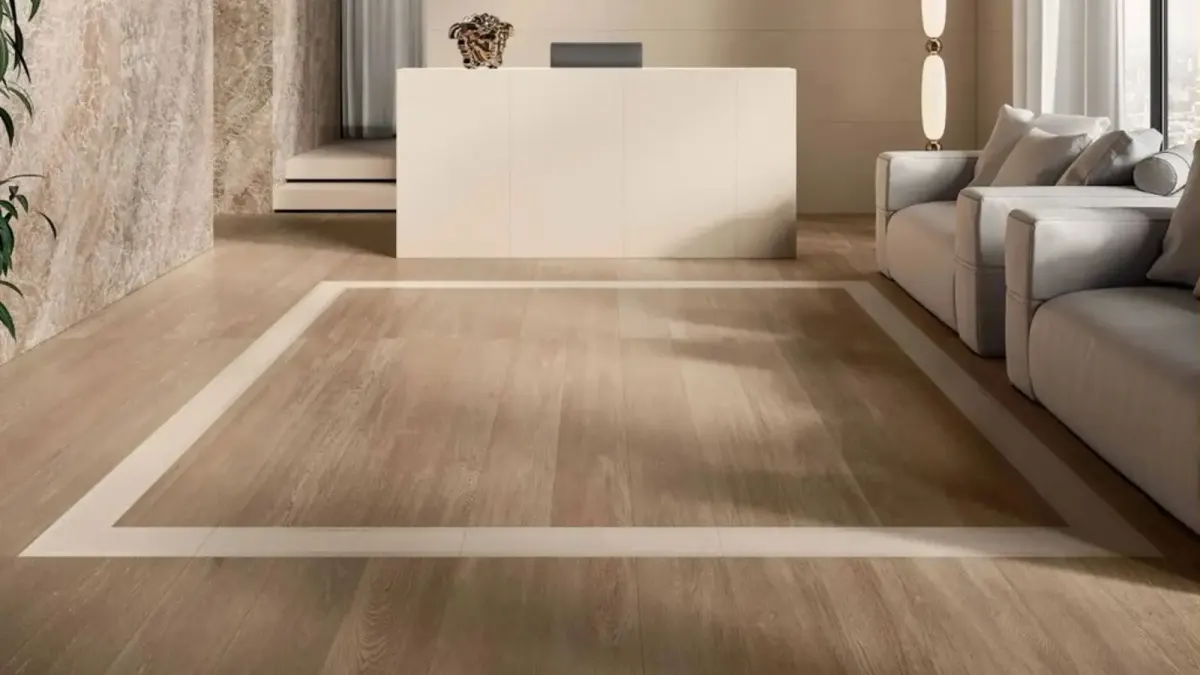
Wood effect tiles are porcelain tiles printed with high-definition inkjet technology to reproduce the grain, knots, colour and tonal movement of real timber, giving you the warmth and character of a wood floor with the performance of porcelain.
Because porcelain has a water absorption rate below 0.5%, wood effect tiles are effectively waterproof, so they can go where real wood cannot: bathrooms, wet rooms, kitchens, hallways and over underfloor heating. They never need sanding, oiling, sealing or refinishing, they do not warp, swell, cup or fade, and they resist scratches, stains and daily wear far better than timber, engineered wood or laminate. Available in plank and square formats, in oak, walnut, ash and smoked looks, and laid in straight, herringbone or chevron patterns, they let you run one warm, natural-looking floor through a whole home, wet rooms included.
That is the direct answer. But the more useful question is how to choose and use wood effect tiles like a designer, rather than simply picking the plank that looks nice on a website. Effect porcelain is Design Di Lusso's exact specialism, and in this guide our design team shares how we actually work with wood effect tiles: what they are, the timber looks that work, where they win, how they compare to real wood and laminate, the laying patterns that transform a room, what to outlay, and the mistakes that cause regret. This is the complete guide, whether you are a homeowner planning one warm bathroom or an architect specifying a continuous floor across a whole project.
What are wood effect tiles, exactly?
Wood effect tiles, sometimes called wood look tiles or plank tiles, are porcelain tiles engineered to look like timber. They are not wood, and they are not wood with a coating: they are a completely different material, high-density fired porcelain, whose surface reproduces the appearance of a real wood plank while behaving far better in wet, busy and heated rooms.
Three pieces of modern technology make today's tiles so convincing.
High-definition inkjet printing
The grain, knots, grooves and colour variation are laid down by high-definition inkjet printing at photographic resolution. Premium ranges print many different plank faces per batch, sometimes dozens, so no two planks look identical and the floor never shows an obvious repeat. This is the single biggest reason the best wood effect tiles read as real timber and older or low-end ones did not.
Textured, structured surfaces
The best ranges add a physical surface texture that follows the printed grain, so the tile feels subtly like wood underhand and catches light the way timber does. Some are given a soft matt or "natural" finish, others a more tactile brushed or structured finish. That texture also does useful work on floors, improving grip.
Plank and square formats, rectified edges
Wood effect porcelain is made in genuine plank proportions, most commonly 200x1200mm and 300x1800mm, alongside shorter planks and square formats for parquet-style looks. Premium planks are rectified, meaning they are mechanically ground to a precise, straight size so they can be laid with very thin grout joints. Thin, tonally matched grout is what makes a tiled floor read as continuous boards rather than a grid of tiles.
The result is a surface with the look of an oak, walnut or ash floor and the performance of porcelain. For a fuller head-to-head on the material choice, see our companion guide on whether wood effect tiles are better than real wood.
The wood looks: oak, walnut, ash and beyond
Half the pleasure of wood effect tiles is choosing the timber look, and each has a distinct character. The right one depends on the mood you want and the light your room gets.
| Wood look | Character | Tone | Best for |
|---|---|---|---|
| Light oak | Warm, natural, timeless | Honey to pale gold | Bright, welcoming whole-home floors |
| Bleached / whitewashed | Calm, Scandinavian, airy | Very pale, cool white-grey | Coastal, minimal and small rooms |
| Natural / mid oak | Classic, versatile, understated | Balanced warm brown | Almost any scheme; safe hero choice |
| Walnut | Rich, luxurious, characterful | Deep chocolate brown | Statement rooms, contrast with pale walls |
| Ash / grey | Contemporary, cool, refined | Soft grey-brown | Modern schemes, matt black or steel brassware |
| Smoked / dark | Dramatic, moody, glamorous | Near-black, charred timber | Feature areas, high-contrast interiors |
A few points our designers draw out. Light and natural oak is the most requested look for good reason: it is warm, timeless and pairs with almost anything, which makes it the safest choice for a floor that runs through a whole home. Walnut and smoked tones read as luxurious and characterful but demand good natural or layered artificial light, because dark floors can feel heavy in a room that does not get much daylight. Grey and ash looks read contemporary and sit beautifully alongside matt black, brushed steel or concrete-effect surfaces. In rooms that get little light, or that are small, a paler oak or whitewashed plank will open the space up; save the dark walnut and smoked looks for rooms that can carry them.
Whatever the tone, view it at scale before committing. A plank that looks mid-brown on a sample can read noticeably darker across a full floor under your own lighting.
Where wood effect tiles win: bathrooms, kitchens, wet areas and UFH
This is the heart of the case for wood effect tiles: they give you a warm, natural wood floor in every place a real wood floor struggles or simply cannot go.
Bathrooms and wet rooms
Real wood and water are a poor match. Timber absorbs moisture, so it swells, cups, stains and eventually rots in a bathroom, and no amount of sealing fully solves it. Because wood effect porcelain has a water absorption rate below 0.5%, it is effectively waterproof and completely at home in a bathroom, including the floor of a walk-in shower or a full wet room, provided you specify a slip-rated finish for wet floors. You get the warmth and character of an oak floor in a room where a real oak floor would fail. This is one of the most popular reasons our clients choose wood effect, and it sits at the centre of a warm, natural luxury bathroom design.
Kitchens
Kitchens punish floors: spills, dropped pans, grease, foot traffic and the occasional flood from an appliance. Wood effect porcelain shrugs all of it off. It does not stain from wine, oil or turmeric the way timber can, it does not scratch under chair legs and pet claws the way a softwood or laminate floor does, and it wipes clean. You get the look of a warm wooden kitchen floor with none of the anxiety.
Underfloor heating
Wood effect porcelain is fully compatible with underfloor heating and is, in fact, one of the best surfaces for it. Porcelain conducts and radiates heat efficiently and is dimensionally stable, so it does not warp or gap as it heats and cools, a real risk with solid and some engineered timber. If you are running underfloor heating, and in a new bathroom or kitchen you almost always should, wood effect tiles let you have both the heat and the wood look with no compromise.
One continuous floor through the home
Because it is equally happy in a living room, a hallway, a kitchen and a bathroom, wood effect porcelain lets you run a single warm floor uninterrupted through an entire home, including the wet rooms. That continuity is a powerful design move: it makes a home feel larger, calmer and more considered, and it is something you simply cannot do with real timber because of the bathrooms.
Wood effect porcelain vs real wood vs laminate and LVT
Clients often arrive weighing wood effect porcelain against real wood, laminate or LVT (luxury vinyl tile). Here is the honest comparison our designers walk people through. The headline: for wet areas, kitchens and underfloor heating, porcelain wins on almost every practical measure, while the visual gap has become very small.
| Factor | Wood effect porcelain | Real / engineered wood | Laminate | LVT (luxury vinyl) |
|---|---|---|---|---|
| Waterproof | Yes (<0.5% absorption) | No, warps and stains | No, swells at joints | Water-resistant, not fully waterproof |
| Suitable for wet rooms | Yes, including shower floors | No | No | Limited |
| Underfloor heating | Fully compatible, efficient | Restricted, can gap | Restricted | Compatible, lower output |
| Scratch resistance | Very high | Low to moderate | Moderate, wears | Moderate, can dent |
| Sealing / refinishing | None, ever | Sanding, oiling, resealing | None, but not repairable | None |
| Fade resistance | Excellent, UV-stable | Fades and ambers | Can fade | Can fade |
| Lifespan | Decades | Decades if maintained | Shorter | Shorter |
| Underfoot feel | Firm, like stone | Warm, natural give | Firm, hollow | Softer, warmer |
| Cost to buy | Premium | Premium to very high | Low-end | Low-end to mid |
| Cost to live with | Minimal | High (maintenance, repair) | Replacement | Replacement |
A few points worth drawing out, because they cause the most regret when people choose wrong.
Water is the deciding factor. If a floor will ever get wet, from a bathroom to a busy family kitchen, porcelain is the only option here that is genuinely, permanently waterproof. Real wood and laminate both fail around water over time, and LVT is water-resistant rather than truly waterproof.
Refinishing cuts both ways. Real wood's one advantage is that it can be sanded and refinished, so deep damage can be repaired. But that same process is a lifetime of cost and disruption, and porcelain simply does not accumulate the damage that would require it.
Underfoot feel is the honest trade-off for porcelain. A real timber floor has a warmth and slight give underfoot that porcelain, being a hard surface, does not replicate exactly. For most clients, underfloor heating more than closes that gap, warm porcelain feels wonderful underfoot, but it is an honest point: wood effect porcelain looks like wood, it is not wood.
Our clear recommendation: for any bathroom, wet room, kitchen or heated floor, and for one continuous floor across a home, choose wood effect porcelain. The only time we would steer a client toward real timber is a dry, low-traffic room where the tactile warmth of solid wood is the specific, prized goal and the client accepts the maintenance. For a deeper look at that exact decision, see are wood effect tiles better than real wood.
Laying patterns: plank, herringbone and chevron
The pattern you lay wood effect tiles in changes the character of a room as much as the timber tone does. This is where a wood floor becomes a design statement.
Straight plank
The classic. Long planks laid in a running bond, with each row offset from the last, read as a traditional board floor. Offsets of a third or a quarter of the plank length look more natural than a straight 50% brick bond, which can over-emphasise the joints. Straight plank is the calmest, most versatile pattern and the easiest to lay well. Running the planks along the longest sightline makes a room feel longer.
Herringbone
Herringbone, where rectangular planks meet at right angles in a zig-zag, is the pattern of the moment and for good reason: it brings movement, craftsmanship and a sense of luxury that a straight floor does not. It suits both classic and contemporary interiors, and it works beautifully in bathrooms, hallways and kitchens. Because it involves angled cuts and more planks, it needs more material and more skilled installation, outlay roughly 10 to 15 percent extra tiles for cuts and wastage. Our dedicated guide covers the detail: herringbone wood effect porcelain tiles.
Chevron
Chevron is herringbone's more formal cousin: the planks are cut at an angle at their ends so they meet in a continuous, unbroken V down the floor, rather than the interlocking L of herringbone. The effect is elegant, directional and distinctly high-end, but the angled cuts make it the most demanding pattern to lay and the most material-hungry. It rewards a large, well-lit room where the continuous point can run uninterrupted.
Choosing a pattern
Match the pattern to the room and the effort you want to invest. Straight plank for calm, versatile floors and larger areas on a sensible outlay of labour; herringbone for a warm, characterful statement that still feels natural; chevron for the most formal, luxurious and directional look. Whatever you choose, herringbone and chevron in particular demand a flat, properly prepared substrate and an experienced fitter, this is not a pattern to compromise the installation on.
How much do wood effect tiles cost?
Pricing varies by range, format, finish and pattern, but the essential point is this: wood effect porcelain sits in the premium tile bracket, and its total cost of ownership is low because there is no maintenance, refinishing or replacement to factor in over its life. As a guide, our design team thinks in bands:
- Entry premium (around £30 to £50 per square metre). Solid, convincing plank ranges in popular oak and grey tones, straight-lay, matt finish. A strong choice for larger continuous floors.
- Mid premium (around £50 to £80 per square metre). More plank faces per batch for greater realism, richer walnut and smoked tones, textured surfaces and larger or longer plank formats.
- Top premium (£80 per square metre and upward). The most realistic ranges with deep surface texture, extensive face variation, long-plank and designer formats, and the tactile finishes that read as genuine timber.
Two costs sit alongside the tiles themselves and should be factored in from the start. First, pattern: herringbone and chevron need 10 to 15 percent extra tiles and more skilled labour than straight plank. Second, installation: wood effect porcelain, especially long planks and angled patterns, demands a flat substrate and an experienced fitter, and this is not a place to economise, the quality of the fit is what separates a designer floor from an ordinary one. Our team can give accurate, project-specific pricing once we understand your area, format and pattern.
How to choose wood effect tiles: a designer's checklist
- Match the tone to your light. Pale oak and whitewashed looks open up small or dark rooms; save walnut and smoked tones for spaces with good natural or layered light.
- Choose a range with high face variation. The more different plank faces per batch, the more the floor reads as real wood and the less it repeats. Ask how many faces a range has.
- Specify rectified planks so they can be laid with thin, tonally matched grout, the single detail that makes tiles read as continuous boards.
- Match the grout to the plank, not to a contrasting colour. A tone-on-tone grout disappears; a contrasting one draws a grid across your "wood".
- Match finish to location. For any wet floor, specify a textured, slip-rated finish (look for R10 or above, R11 for wet rooms and shower floors). Walls and dry areas allow softer finishes.
- Decide the pattern early, because herringbone and chevron change the tile quantity, the layout and the labour, and are best planned before you order.
- Run one floor through the home where you can. Continuity of tone and pattern across rooms, wet rooms included, is what makes wood effect porcelain feel considered rather than incidental.
- See it at full scale, under your lighting, before committing. A single plank tells you very little about how a floor will read.
Common mistakes to avoid
Honesty matters more than hype, so here is where wood effect tiles go wrong, and how to avoid it.
- Choosing a low-end range with few plank faces. The giveaway of a poor wood effect tile is obvious repetition, the same knot appearing every few planks. Insist on high face variation.
- Contrasting grout. A dark grout against a pale plank draws a tile grid across the floor and destroys the wood illusion. Match grout to the plank tone.
- A gloss finish on a wet floor. Beautiful wood effect can be too slippery when wet if the wrong finish is chosen. Specify a slip-rated textured finish for any floor that gets wet.
- A 50% brick-bond offset on long planks. A halfway offset over-emphasises the joints and can look unnatural; a third or quarter offset reads far more like a real board floor. It also puts plank centres over adjacent joints, which can cause lippage on long formats, another reason to avoid it.
- Under-ordering for herringbone or chevron. These patterns waste 10 to 15 percent in angled cuts; order the extra up front so all your tiles come from the same batch.
- Economising on installation. Long planks and angled patterns show every imperfection in a poorly prepared floor. A flat substrate and a skilled fitter are non-negotiable.
- A dark floor in a dark room. Walnut and smoked looks are stunning, but in a room with little light they can feel heavy and closed-in. Match tone to light.
None of these are reasons to avoid wood effect tiles, they are reasons to specify them thoughtfully. Get the range, grout, finish and installation right, and the cautions above simply do not arise.
Frequently asked questions
Are wood effect tiles waterproof?
Yes. Wood effect tiles are porcelain, and porcelain has a water absorption rate below 0.5%, which makes it effectively waterproof. That is why they are ideal for bathrooms, wet rooms, kitchens and any area exposed to water, including shower floors when a slip-rated finish is specified. Real wood, engineered wood and laminate all fail around water over time, which is the single biggest reason clients choose wood effect porcelain.
Are wood effect tiles better than real wood?
For wet areas, kitchens and underfloor heating, yes, they are waterproof, scratch-resistant, need no sanding or refinishing and do not warp or fade. Real wood's advantage is a slightly warmer feel underfoot and the ability to be refinished. For most homes, and certainly for one continuous floor including bathrooms, wood effect porcelain is the more practical choice. See our full comparison for the detail.
Can wood effect tiles be used with underfloor heating?
Yes, they are one of the best surfaces for underfloor heating. Porcelain conducts and radiates heat efficiently and is dimensionally stable, so it does not warp or gap as it heats and cools, unlike solid and some engineered timber, which is restricted over underfloor heating. If you are installing underfloor heating in a bathroom or kitchen, wood effect porcelain lets you have both the heat and the wood look.
Do wood effect tiles look fake?
Premium ranges do not. Older or low-end tiles looked fake because they repeated the same plank face and were laid with thick, contrasting grout. Modern high-definition inkjet printing, many plank faces per batch, rectified planks, textured surfaces and thin tonal grout produce a floor most people cannot distinguish from real timber. Choosing a high-variation range and matching the grout are what make the difference.
What is the best size for wood effect tiles?
Long plank formats such as 200x1200mm and 300x1800mm read most convincingly as real boards, and longer planks make a room feel larger. Shorter planks and squares suit parquet, herringbone and chevron patterns. The right size depends on the room and the pattern; our showroom team can help you match format to space so the proportions look natural.
Can you lay wood effect tiles in a herringbone pattern?
Yes, herringbone is one of the most popular ways to lay wood effect porcelain and looks stunning in bathrooms, hallways and kitchens. It needs 10 to 15 percent extra tiles for the angled cuts, a flat, well-prepared substrate and an experienced fitter to keep the pattern true. Chevron is also possible for an even more formal look. See our dedicated herringbone guide for the detail.
Do wood effect tiles need sealing?
No. Wood effect porcelain is non-porous, with a water absorption rate below 0.5%, and the wood pattern sits under a fired, hard surface, so there is nothing for a sealer to protect. You never seal or refinish it, unlike real wood, which needs oiling or sealing and periodic sanding. Only the grout benefits from a stain-resistant or epoxy specification in wet areas.
Are wood effect tiles cold underfoot?
Porcelain is a hard surface, so on its own it feels cool underfoot, like stone. The simple, and standard, answer is underfloor heating, which porcelain conducts and radiates beautifully, giving you a warm floor that also looks like wood. In a bathroom or kitchen we almost always recommend pairing wood effect tiles with underfloor heating for exactly this reason.
Bringing it together
Wood effect tiles solve a problem real timber never could: they give you the warmth, grain and character of a wood floor in every room of the home, wet rooms and kitchens included, with none of the warping, staining, scratching or refinishing that timber brings. Choose a high-variation range in a tone that suits your light, lay it in straight plank, herringbone or chevron with thin tonal grout and a skilled fitter, and pair it with underfloor heating, and you have a floor that looks like wood, performs like porcelain and can run beautifully and uninterrupted through an entire home. It is warmth and character without compromise, which is exactly why it is one of the surfaces our design team specifies most.
See wood effect tiles in person at our Watford showroom
Wood effect porcelain is a surface you really have to see at full scale: a single plank cannot show you the face variation, the texture, or how a herringbone floor reads across a whole room. Visit our 7,000 sq ft showroom in Watford to experience our wood effect collections under proper lighting, see oak, walnut, ash and smoked looks in long-plank format and in herringbone, and talk your floor through with our award-winning team. Whether you are a homeowner planning one warm bathroom or an architect specifying a continuous floor across a project, we will help you use wood effect tiles beautifully, and every visit begins with a free design consultation.
Book your free consultation at our Watford showroom →
Design Di Lusso (DDL Tiles), Watford, Luxury Lifestyle Awards Top 100 Best of the Best 2025, and effect-porcelain specialists. Explore our wood effect tiles, read whether wood effect tiles are better than real wood and herringbone wood effect porcelain tiles, or plan a warm luxury bathroom design.