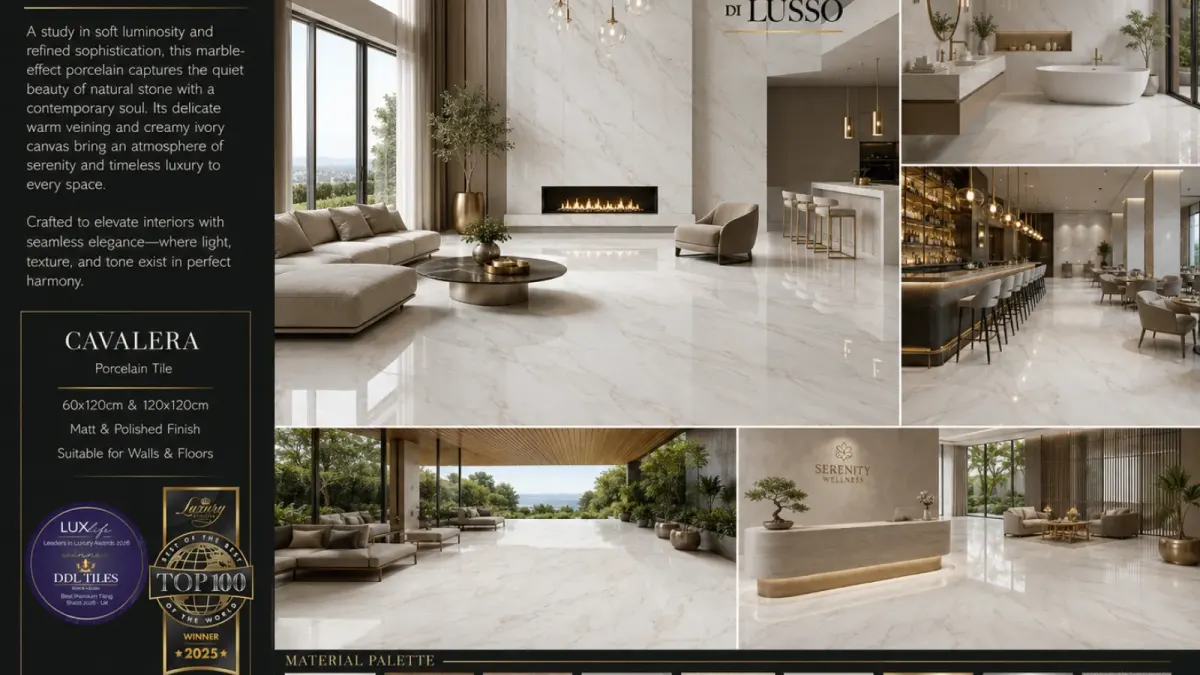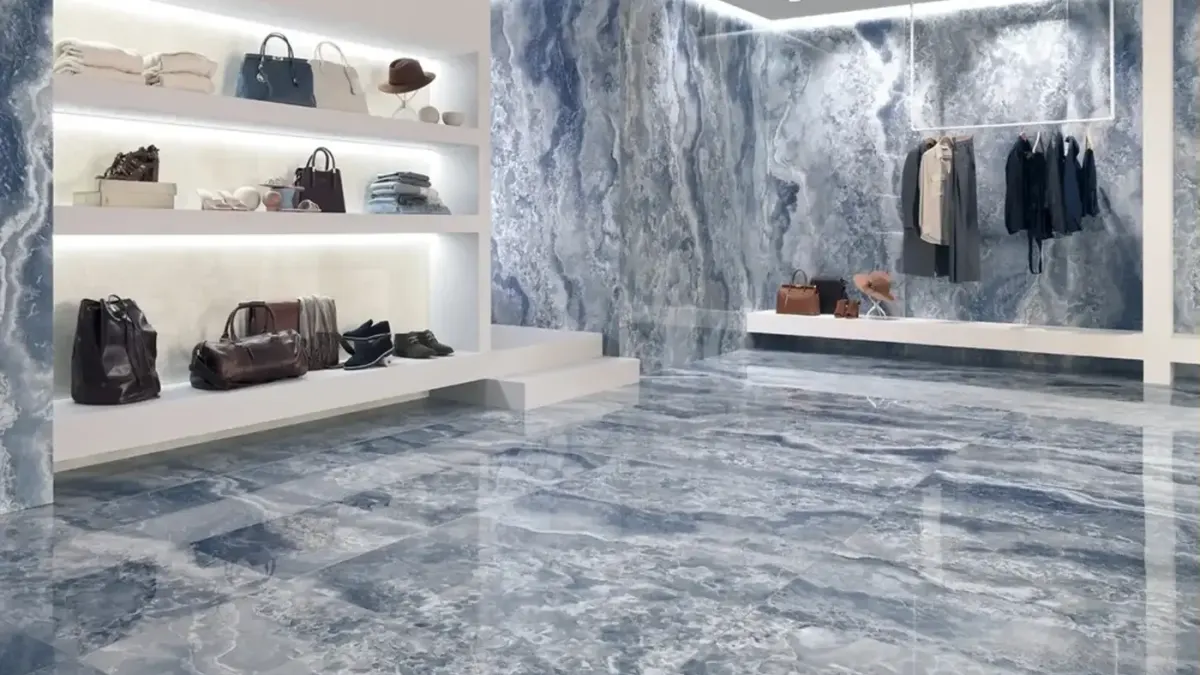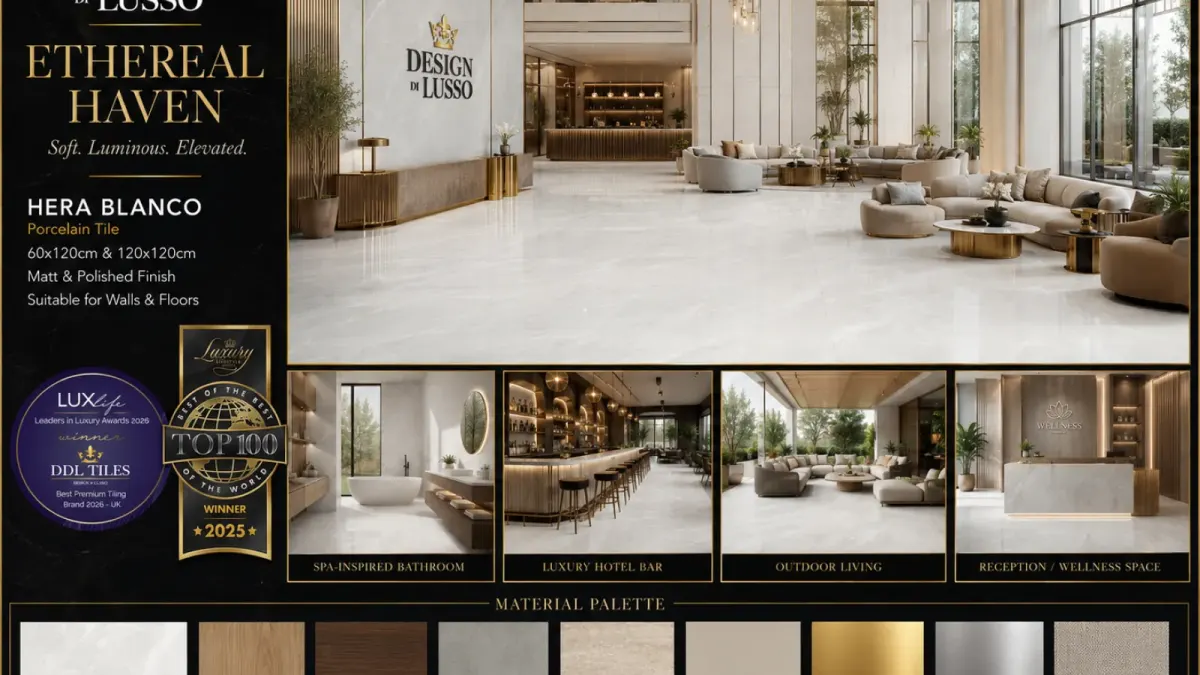
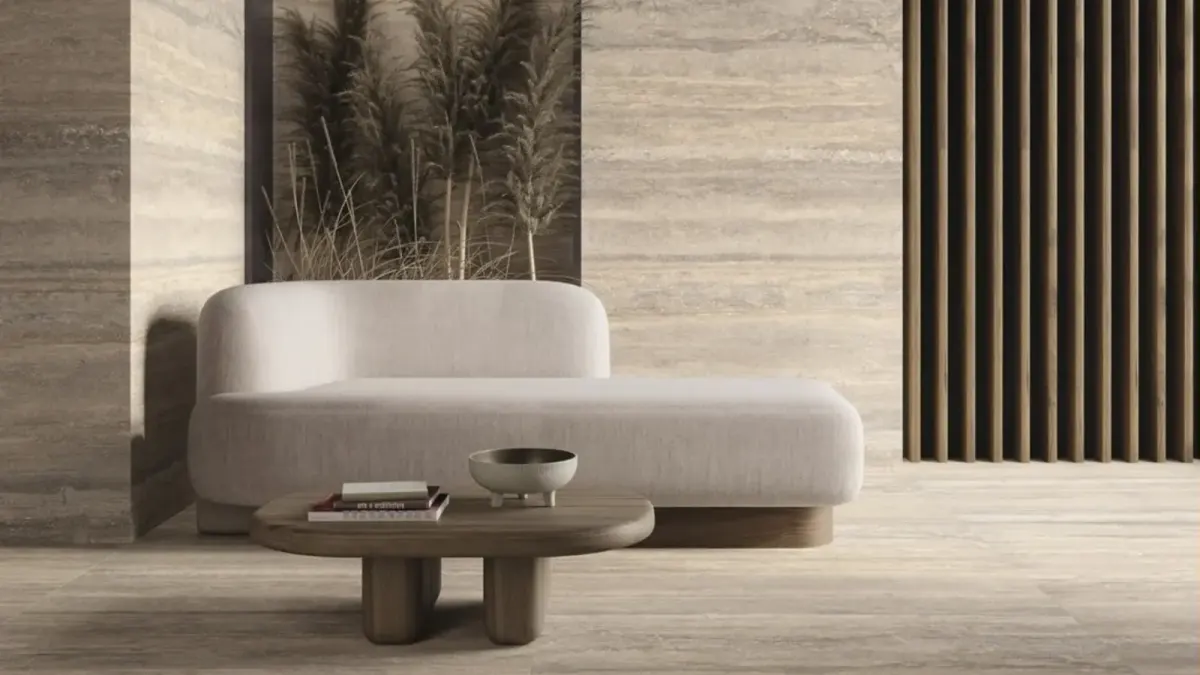
The complete guide to stone effect tiles: travertine, limestone and slate looks, porcelain vs real stone, indoor and outdoor use, finishes and cost.
Stone effect tiles are porcelain tiles whose surface reproduces the colour, texture and character of natural stone, engineered to look like travertine, limestone, slate or marble while performing far better than the real thing.
Because porcelain has a water absorption rate below 0.5%, the tiles are virtually non-porous: they never need sealing, don't absorb water or stains, resist scratches, and are frost-proof, so the same stone look runs from indoor floors to bathrooms, wet rooms and outdoor terraces. High-definition inkjet printing and surface texturing reproduce the pitted warmth of travertine, the soft matt neutrality of limestone and the riven depth of slate so convincingly that most people cannot tell them from quarried stone. With slip ratings matched to each location, stone effect porcelain gives you the natural, tactile beauty of real stone without the porosity, sealing and constant maintenance.
This guide is the complete reference our design team wishes every client had before choosing stone effect tiles. As effect-porcelain specialists, we cover what these tiles actually are, the classic stone looks and their characters, how stone effect porcelain compares honestly to real natural stone, the finishes and slip ratings that keep floors safe, how to run one look from inside to your garden without a visible break, realistic cost bands, and the mistakes we most often help clients avoid. Read it in order for a full education, or jump to the section that answers your question.
What are stone effect tiles, exactly?
Stone effect tiles are not coated or resin-topped stone. They are porcelain, a completely different, engineered material, made to look like natural stone while behaving far better in wet, high-traffic and outdoor settings. Understanding the technology explains why today's tiles are so convincing.
The technology that makes them convincing
Two things do the heavy lifting. The first is high-definition inkjet printing, which reproduces the colour, mineral streaking and tonal variation of real stone at photographic resolution, using many different faces per batch so a floor never repeats obviously. The second is surface texturing: the tile face is structured to mimic the pitted surface of travertine, the soft grain of limestone or the riven cleft of slate, so the tile feels like stone underfoot as well as looking like it.
Porcelain vs ceramic: the technical line
The word "porcelain" is not marketing. Porcelain is defined by a water absorption rate below 0.5%, the technical line separating it from ordinary ceramic. That low absorption makes stone effect porcelain virtually non-porous, waterproof in practice, and frost-proof, the qualities that let one stone look run from a bathroom floor to an outdoor terrace. The colour and texture are fired into a hard body, so there is nothing for water, stains or frost to penetrate.
The result is a surface with the tactile look of natural stone and the performance of porcelain, which is exactly why stone effect porcelain has become the default choice for indoor-outdoor stone schemes.
The stone looks: travertine, limestone, slate and marble-adjacent
Each natural stone has a distinct character, and the right one depends on the mood you want and where you are using it. Here is how our designers describe the main options.
| Stone look | Character | Colour & texture | Best for |
|---|---|---|---|
| Travertine | Warm, Mediterranean, classic | Cream to walnut, soft pitted surface | Bathrooms, hallways, indoor-outdoor floors |
| Limestone | Soft, calm, understated | Neutral beige, grey, taupe; fine matt grain | Whole-room floors, calm modern schemes |
| Slate | Rugged, characterful, dramatic | Charcoal, graphite, multi-tone; riven texture | Feature floors, wet rooms, hardy hallways |
| Marble-adjacent stone | Refined, luxurious, veined | Soft veining and movement, honed finish | Elegant bathrooms and living spaces |
Travertine effect is the warm, timeless classic, its creamy tones and characteristic pitting bring a Mediterranean, hotel-spa feel and work indoors and out. We go deeper on it here: travertine natural stone effect porcelain tiles. Limestone effect is the quiet, contemporary choice, soft neutral tones and a fine matt grain that tile an entire floor without drawing attention. Slate effect is the rugged, dramatic option, deep charcoals and greys with a riven, textured surface that suits both modern and rustic schemes and gives excellent grip. Marble-adjacent stone looks bridge stone and marble, refined honed surfaces with gentle movement for more elegant rooms.
Stone effect porcelain vs real natural stone: the honest comparison
Clients often arrive wondering whether to use real quarried stone or the porcelain version. Here is the comparison our designers actually walk people through. The headline: for almost every real-world floor, porcelain wins on practicality, and the visual and tactile gap is now very small. For the full deep-dive, see stone effect vs real natural stone tiles.
| Factor | Real natural stone | Stone effect porcelain |
|---|---|---|
| Porosity | Porous, absorbs water and stains | Non-porous, water absorption <0.5% |
| Sealing | Required on install + re-sealed for life | None, ever |
| Staining | Stains readily (wine, oil, coffee) | Stain-resistant |
| Frost resistance | Can crack in frost if saturated | Frost-proof |
| Durability | Softer stones scratch, chip, wear | Hard, scratch-resistant, hard-wearing |
| Colour consistency | Varies batch to batch, hard to match | Consistent, easy to re-order and match indoor/outdoor |
| Maintenance | High, careful pH-neutral care | Minimal, normal cleaning |
| Cost to live with | High (sealing, repairs, refinishing) | Low |
Porosity and sealing: the core difference
Real stone, especially travertine and limestone, is porous. It absorbs water and stains, so it must be sealed on installation and re-sealed periodically for life, and even then remains vulnerable to wine, oil and coffee marks. Porcelain is non-porous, with a water absorption rate below 0.5%, so it never needs sealing and shrugs off spills. This single difference is why we specify porcelain for the great majority of floors.
Frost, durability and matching
Saturated natural stone can crack in a hard frost, which limits its outdoor use in the UK; frost-proof porcelain does not. Softer stones also scratch, chip and wear, while porcelain is one of the hardest surfaces you can put in a home. And because porcelain is manufactured, you can re-order it and match indoor floor tiles to frost-proof 20mm outdoor pavers in the same look, something quarried stone rarely allows.
Our clear recommendation: for any wet, high-traffic or outdoor surface, choose stone effect porcelain. The tactile gains of real honed stone rarely outweigh the lifetime of sealing, staining and repair it brings.
Indoor and outdoor use: one look, inside and out
The single greatest advantage of stone effect porcelain is that it lets you run the same stone look from your interior floors straight out onto a terrace, because frost-proof ranges are made in matching indoor tiles and outdoor pavers.
The unbroken indoor-outdoor floor
Many ranges pair a standard 9-10mm indoor floor tile with a 20mm structural outdoor paver in the identical colour and texture. Level the thresholds, keep the grout tone consistent, and the floor reads as one continuous stone surface from kitchen to garden, one of the most sought-after details in contemporary home design. Explore the outdoor side here: outdoor porcelain tiles.
Why porcelain beats stone outdoors
Outdoors, porcelain's advantages multiply. It is frost-proof, so it won't crack in winter; non-porous, so it won't absorb rain, moss or ground stains; and colour-stable, so it won't fade in sunlight. Real stone outdoors needs sealing, grows slippery with algae and can spall in frost. A 20mm porcelain paver simply performs, year after year, with a jet-wash and nothing more.
Poolside, patios and paths
For patios, poolside and paths, specify an anti-slip outdoor finish (see below). Travertine, limestone and slate looks all translate beautifully outdoors, giving a natural, high-end landscape without the upkeep of quarried stone.
Finishes and slip ratings: keeping floors safe
Stone effect porcelain is made in different finishes with different slip ratings, so the rule is to match finish to location.
- Matt / honed finishes suit indoor floors and walls in bathrooms and living areas, calm and natural underfoot.
- Textured / structured "grip" finishes carry the riven feel of slate or pitted travertine and give extra grip for indoor wet areas. Look for an R-rating of R10 or above for bathroom floors and R11 for shower floors and wet rooms.
- Anti-slip outdoor / 20mm pavers are engineered for external use, typically R11 to R13, so terraces, paths and poolsides stay safe in the wet.
A cohesive approach is to run a matt or lightly textured stone effect on indoor floors and the matching anti-slip outdoor paver in the same look outside, so the transition is smooth but each area is correctly rated. Our team always confirms slip ratings for floor specifications, especially wet rooms, poolsides and households with children or older family members.
Where to use stone effect tiles
Because it is non-porous, hard-wearing and frost-proof, stone effect porcelain works almost everywhere:
- Bathroom floors and walls, warm travertine or calm limestone for a natural, spa-like feel with none of stone's sealing.
- Wet rooms and shower floors, non-porous and, with a slip-rated finish, safe underfoot.
- Kitchens and hallways, hard-wearing floors that resist the traffic, spills and grit that would mark real stone.
- Living spaces, large-format limestone or marble-adjacent looks for a calm, continuous floor.
- Terraces, patios and poolsides, frost-proof 20mm pavers that match the indoor floor.
- Feature walls and fireplaces, riven slate looks for texture and drama.
How much do stone effect tiles cost?
Pricing varies by range, size, finish and thickness, but the essential point is this: stone effect porcelain sits in the premium tile bracket, yet is a lower investment than most real quarried stone, and far lower once you account for lifetime maintenance. Real stone carries the cost of the material, sealing on installation, repeated re-sealing, and repairs of stains, scratches and frost damage, expenses that continue for as long as you own the surface.
As a guide to the porcelain bands:
- Entry premium ranges: solid, convincing travertine, limestone and slate looks in standard formats.
- Mid premium ranges: better resolution, more faces per batch, larger formats and textured finishes.
- Top premium ranges: large-format, deeply textured stone with matching frost-proof 20mm outdoor pavers for continuous indoor-outdoor schemes.
Outdoor 20mm pavers are a higher investment per square metre than indoor tiles, which is worth factoring in for terrace projects. But the lifetime cost stays low: no sealing, no refinishing, no specialist care. Our design team can give accurate, project-specific pricing once we understand the area, range and format you are considering.
How to choose stone effect tiles: a designer's checklist
- Choose the stone character first: warm travertine, calm limestone, dramatic slate or refined marble-adjacent.
- Match finish to location: matt or honed indoors, textured for wet areas, anti-slip 20mm pavers outdoors.
- Plan indoor-outdoor as one scheme if you want an unbroken floor, and confirm the range offers matching pavers.
- Confirm slip ratings (R10+ indoors wet, R11-R13 outdoors) before you commit.
- Keep grout tone natural and consistent across the transition; a soft stone-tone grout reads best.
- Go large-format on floors for fewer grout lines and a more natural, expansive stone look.
- Order a little extra for future repairs, and note the batch, though porcelain matches far more reliably than quarried stone.
- See it at scale under real lighting before committing, stone texture and tone read very differently on a full floor than on a sample.
Common mistakes to avoid
- Using an indoor finish outdoors. Standard indoor tiles are not rated for external slip or structural paving. Always specify an anti-slip 20mm paver outside.
- Ignoring slip ratings on wet floors. A smooth stone effect on a shower floor is a hazard; specify R11 or a wet-barefoot rating.
- Mismatched grout across the threshold. A change of grout tone breaks the indoor-outdoor illusion. Keep it consistent.
- Assuming all "travertine effect" is equal. Print resolution, texture and the number of faces per batch vary hugely; lower-end ranges repeat and look flat.
- Choosing real stone for a wet or outdoor floor to "save money". The lifetime cost of sealing, staining and frost repair usually exceeds the porcelain investment.
- Buying from a small sample. Stone tone and texture read completely differently across a full floor, always view large tiles under proper lighting.
Frequently asked questions
Do stone effect porcelain tiles need sealing?
No. Stone effect porcelain is non-porous, with a water absorption rate below 0.5%, so there is nothing for a sealer to protect. You never seal it on installation or re-seal it, unlike real travertine, limestone and slate, which are porous and must be sealed on install and re-sealed for life. Only the grout benefits from a stain-resistant specification in wet areas.
Can stone effect tiles be used outdoors?
Yes, this is one of their best uses. Frost-proof porcelain won't crack in winter, won't absorb rain or ground stains, and won't fade in sunlight. Specify a structural 20mm paver in an anti-slip finish (typically R11 to R13) for terraces, patios and poolsides. Many ranges offer matching indoor tiles and outdoor pavers for a continuous indoor-outdoor floor.
What is the difference between travertine, limestone and slate effect?
Travertine effect is warm and creamy with a soft pitted surface, Mediterranean and classic. Limestone effect is soft, neutral and fine-grained, calm and contemporary. Slate effect is rugged and dark with a riven, textured surface that suits drama and gives excellent grip. All three are reproduced in non-porous, hard-wearing porcelain.
Are stone effect tiles slippery?
Only if you choose the wrong finish for the surface. Use matt or honed finishes on indoor floors, textured slip-rated finishes (R10 or above, R11 for wet rooms) for wet areas, and anti-slip 20mm pavers (R11 to R13) outdoors. The naturally textured surface of slate and travertine effect helps grip, but always confirm the rating for the location.
Stone effect porcelain vs real natural stone: which is better?
For almost every real-world floor, porcelain. It is non-porous, never needs sealing, resists stains and scratches, is frost-proof and colour-consistent for easy matching. Real stone offers a genuine tactile patina but brings porosity, lifelong sealing, staining and frost risk. Porcelain gives the look and feel of stone with none of the maintenance.
Do stone effect tiles look real?
Premium ranges do. High-definition inkjet printing reproduces stone colour and mineral streaking at photographic resolution, and surface texturing recreates the pitting of travertine, the grain of limestone and the cleft of slate, so the tile feels like stone underfoot as well as looking like it. Most people cannot tell a quality stone effect from quarried stone.
Can I match indoor floors to an outdoor terrace?
Yes, and it is one of the most sought-after details in home design. Many stone effect ranges pair a 9-10mm indoor tile with a matching 20mm frost-proof outdoor paver in the identical colour and texture. Level the thresholds and keep the grout tone consistent, and the floor reads as one continuous stone surface from inside to garden.
Are stone effect porcelain tiles hard-wearing?
Very. Porcelain is one of the hardest surfaces you can put in a home, scratch-resistant, frost-proof and able to take heavy foot traffic, grit and spills without wearing or staining. This makes it far more durable than softer natural stones like travertine and limestone, which scratch, chip and stain more easily in everyday use.
The last word: natural stone beauty that actually performs
Stone effect porcelain lets you have the warmth of travertine, the calm of limestone, the drama of slate and the refinement of marble-adjacent stone without the porosity, sealing, staining and frost risk of the real thing. Choose the right stone character, match finish to location, plan indoor and outdoor as one scheme, and you get a surface that looks and feels like natural stone yet is virtually maintenance-free for decades, indoors and out. That combination is exactly why it is a surface our design team specifies so often.
See stone effect tiles in person at our Watford showroom
Stone effect porcelain is a material you really have to see and feel at full scale, photographs and small samples cannot capture the texture, tonal variation or the way one look runs from floor to terrace without a break. Visit our 7,000 sq ft showroom in Watford to experience our travertine, limestone, slate and marble-adjacent collections under proper lighting, feel the finishes underfoot, and talk through your project with our award-winning team. As effect-porcelain specialists serving Watford and the surrounding areas, we offer a free design consultation whether you are a homeowner or a designer specifying for a client.
Book your free design consultation at our Watford showroom →
Design Di Lusso (DDL Tiles), Watford, Luxury Lifestyle Awards Top 100 Best of the Best 2025. Explore our stone-effect tiles, compare stone effect vs real natural stone, and see our outdoor porcelain tiles.