The complete guide to marble effect porcelain tiles: the marble looks, where to use them, porcelain vs real marble, sizes, cost bands and how to choose.
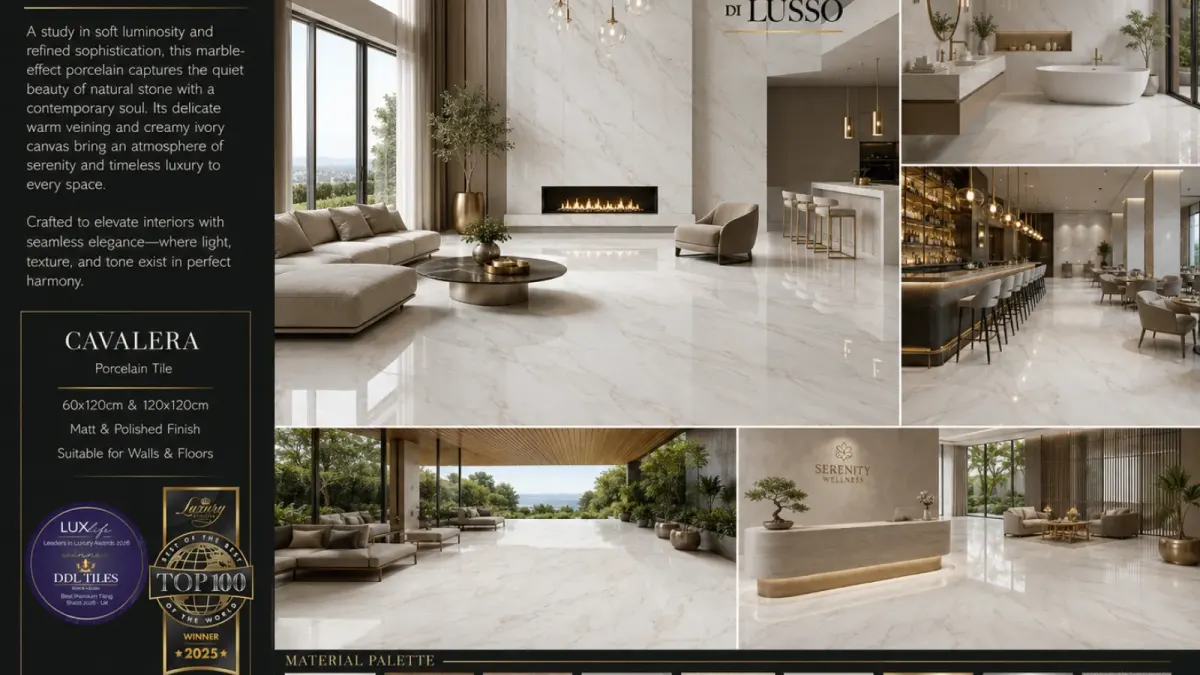
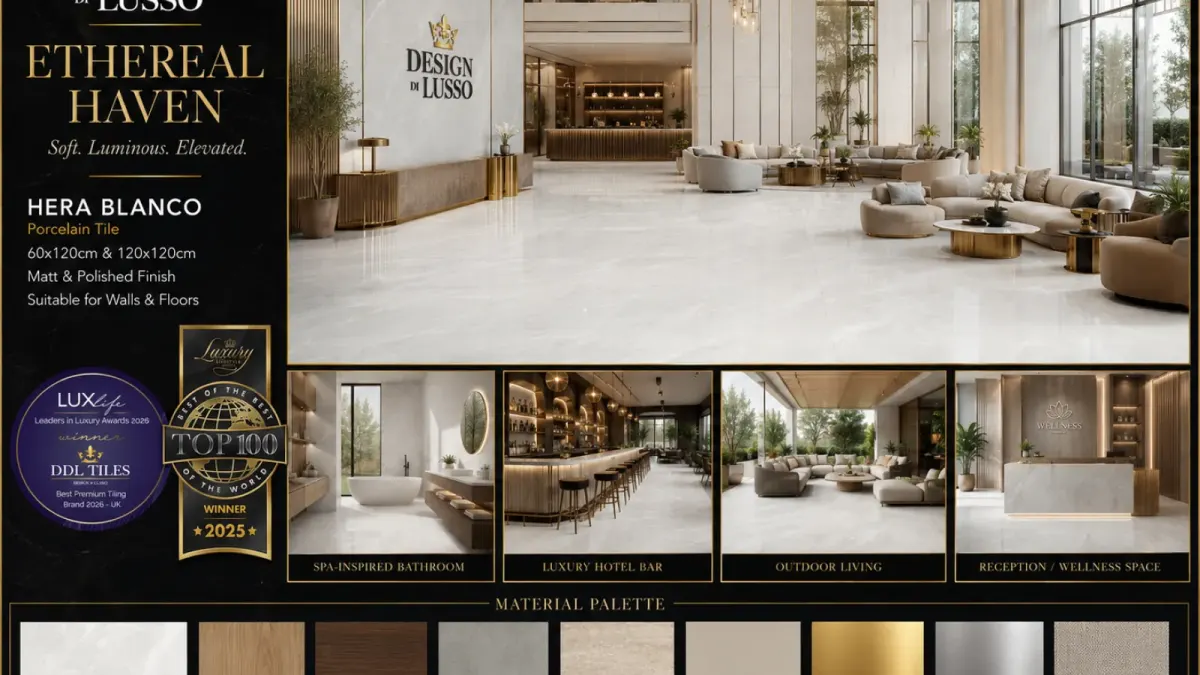
Marble effect porcelain tiles are high-density porcelain tiles whose surface reproduces the veining, colour and depth of natural marble, engineered to look like Calacatta, Carrara, Statuario or Nero marble while performing far better in real, used rooms.
Because porcelain has a water absorption rate below 0.5%, the tiles are virtually non-porous: they never need sealing, don't etch from acids like toothpaste and cleaning sprays, resist stains and scratches, and are frost-proof indoors and out. Modern high-definition inkjet printing and rectified, large-format formats reproduce marble so convincingly that most people cannot tell the difference, and on book-matched ranges the veining flows continuously across tiles like a real marble slab. They suit floors, walls, wet rooms, splashbacks and feature walls, and with a slip-rated finish they work on every surface in the home.
This guide is the complete reference our design team wishes every client had before choosing marble effect porcelain. Marble effect porcelain is Design Di Lusso's exact specialism, and below we cover what these tiles actually are, the classic marble looks and their characters, where to use them (and where not to), how porcelain compares honestly to real marble, the sizes and formats that separate a designer finish from an ordinary one, realistic cost bands, and the mistakes we most often help clients avoid. Read it in order for a full education, or jump to the section that answers your question.
What are marble effect porcelain tiles, exactly?
Marble effect porcelain tiles are not painted or coated stone. They are a completely different material, high-density porcelain, engineered to look like marble while behaving far better in a wet, high-traffic room. Understanding the technology explains why today's tiles are so convincing.
The technology that makes them convincing
Two pieces of modern manufacturing do the heavy lifting. The first is high-definition inkjet printing, which lays down marble veining at photographic resolution, using multiple different faces across a single batch so a floor or wall never repeats obviously. The second is rectified edges: tiles mechanically ground to a precise, perfectly straight size, allowing very thin grout lines and, on premium ranges, vein-matching so the marble pattern flows continuously from one tile to the next.
Porcelain vs ceramic: the technical line
The word "porcelain" is not marketing. Porcelain is defined by a water absorption rate below 0.5%, the technical line that separates it from ordinary ceramic (which absorbs far more water). That low absorption is what makes marble effect porcelain virtually non-porous, waterproof in practice and safe for wet rooms, splashbacks and floors. The colour and pattern are fired into a hard, glazed surface, so there is nothing for water, soap or limescale to penetrate.
The result is a surface with the look of natural marble and the performance of porcelain, and that combination is exactly why marble effect porcelain has become the default luxury surface for bathrooms, kitchens and feature areas.
The marble looks: Calacatta, Carrara, Statuario, Nero and beyond
Half the pleasure of marble effect porcelain is the choice of looks. Each classic marble has a distinct character, and the right one depends on the mood you want to create. Here is how our designers describe the main options.
| Marble look | Character | Ground & veining | Best for |
|---|---|---|---|
| Calacatta | Bold, luxurious, statement | Thick grey and gold veins on bright white | Hero feature walls, statement bathrooms and kitchens |
| Carrara | Soft, classic, understated | Fine, feathery grey veining on soft white | Calm, timeless, whole-room schemes |
| Statuario | Crisp, elegant, gallery-like | Defined grey veins on a very white ground | Bright, light-filled, luxurious rooms |
| Nero Marquina | Dramatic, glamorous, high-contrast | Striking white veins on deep black | Feature walls, powder rooms, accents |
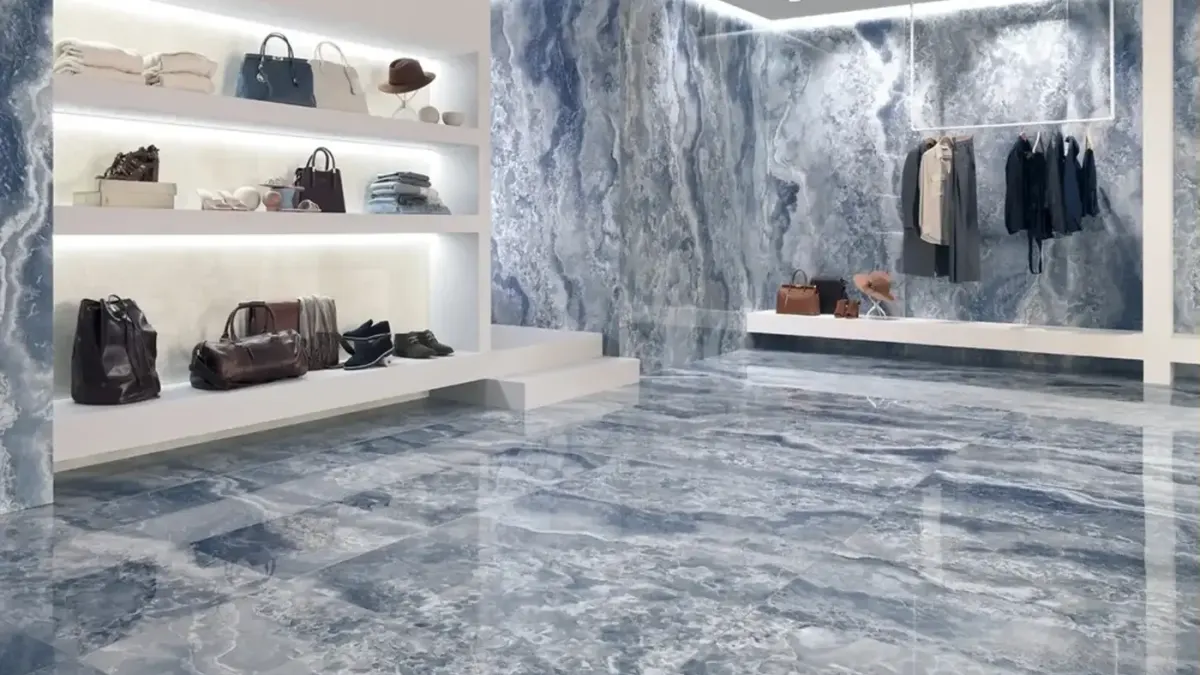
| Grey / Pietra Grey | Contemporary, moody, refined | White or silver veining on mid-to-dark grey | Modern schemes, contrast against white |
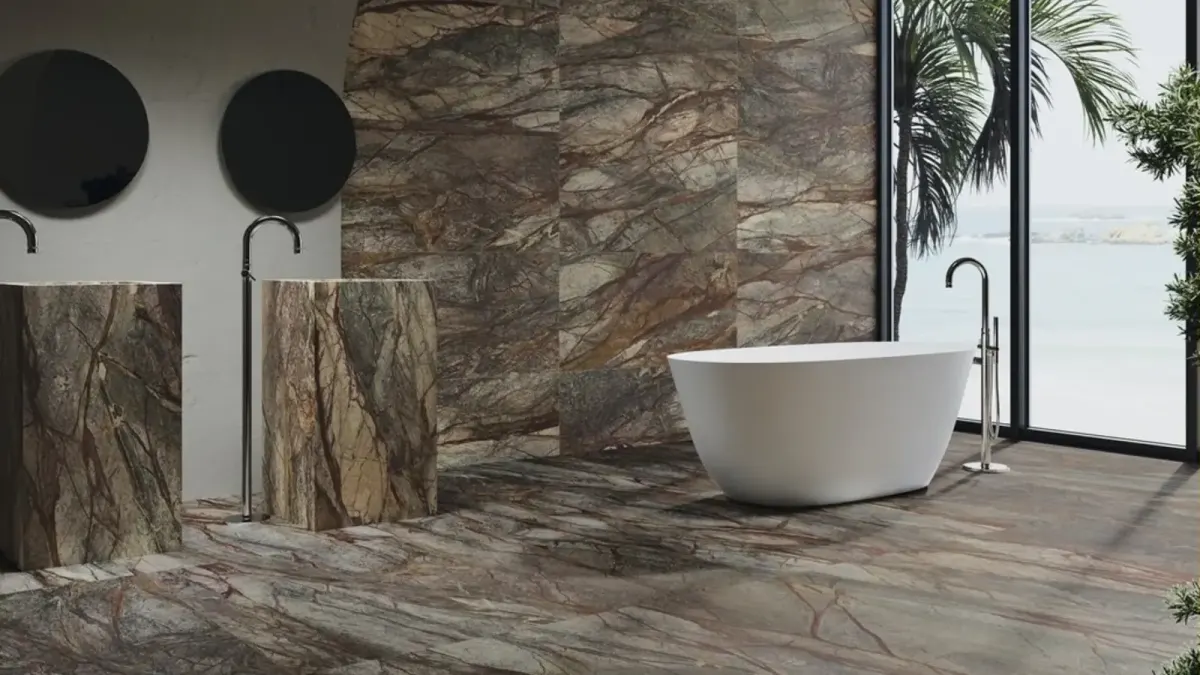
| Green (Verde/Guatemala) | Rich, characterful, on-trend | Bold white or gold veins on deep green | Feature walls, statement vanities, bars |
Calacatta is the most requested look for a reason: its bold gold-and-grey veining on a bright white ground reads as unmistakably luxurious and makes a brilliant feature wall behind a bath, vanity or hob. Carrara is the quieter, more timeless choice, soft enough to tile an entire room without overwhelming it. Statuario sits between the two, crisp and gallery-like. Grey marbles read contemporary and pair beautifully with brushed brass or matt black, while Nero Marquina and green marbles are the drama options, stunning as a single feature or in a small, jewel-like room. Many of our most successful schemes pair a calm Carrara or grey across the room with one bolder Calacatta, Nero or green feature.
Where to use marble effect porcelain tiles
One of the great advantages of marble effect porcelain over real marble is that you can use it almost everywhere. Because it is non-porous and hard-wearing, the same look runs across surfaces that natural stone struggles with.
Bathroom floors and walls
This is the classic application, and marble effect porcelain is arguably the best surface you can choose for it. It gives the luxury of marble with the performance of porcelain: virtually waterproof, stain- and scratch-resistant, and maintenance-free. Run a polished finish on walls for that luminous marble glow and a slip-rated matt version of the same marble on the floor. Our detailed take on this is here: are marble effect porcelain tiles good for bathrooms?
Wet rooms and shower floors
Because porcelain is virtually non-porous, it is ideal for showers and walk-in wet rooms, including the shower floor, where natural marble would need constant sealing and still risk water damage. The only rule is to specify a slip-rated finish for any wet floor (see the finishes section below) and a stain-resistant or epoxy grout.
Feature walls and book-matched panels
The most dramatic use of marble effect porcelain is a book-matched feature wall, where two or more large-format tiles are mirrored so the veining opens out symmetrically like butterfly wings, exactly as a book-matched marble slab does. We explain how this works in what are book-matched tiles? A single Calacatta or Nero book-matched panel behind a freestanding bath or bed is one of the most luxurious details in interior design.
Kitchens, splashbacks and beyond
Marble effect porcelain also works beautifully on kitchen splashbacks, feature walls, hallways and living-room floors, anywhere you want a continuous marble look without the fragility of stone. Frost-proof ranges can even continue the look onto covered terraces and outdoor kitchens.
Porcelain vs natural marble: the honest comparison
Clients often arrive torn between "real" marble and the porcelain version, and understandably so, marble is one of the most beautiful materials in the world. Here is the comparison our designers actually walk people through. The headline is simple: for most real-world surfaces, porcelain wins on almost every practical measure, and the visual gap is now very small. For the full deep-dive, see porcelain vs natural marble in a luxury bathroom.
| Factor | Natural marble | Marble effect porcelain |
|---|---|---|
| Water resistance | Porous, must be sealed | Excellent, water absorption <0.5% |
| Sealing | Required on install + re-sealed for life | None, ever |
| Staining & etching | Etches with acids, stains readily | Acid-resistant, stain-resistant |
| Durability | Soft (approx. 3 on Mohs scale), scratches, chips | Hard, scratch-resistant, frost-proof |
| Maintenance | High, careful pH-neutral care | Minimal, normal cleaning |
| Cost to buy | Very high (slab + fabrication) | Premium, but a lower investment |
| Cost to live with | High (sealing, repairs, refinishing) | Low |
| Best use | Dry feature areas, sealed vanity tops | Bathrooms, wet rooms, floors, anywhere |
Etching: the hidden problem with real marble
Marble is calcium carbonate, so it reacts chemically with acids. Everyday items, toothpaste, perfume, lemon-scented cleaners, wine, even some shampoos, can leave dull, etched marks that no cleaning removes. Porcelain is chemically inert and acid-resistant, so it simply doesn't etch. This single difference is why we so rarely specify real marble for a working bathroom or kitchen.
Durability and sealing
Natural marble is relatively soft (around 3 on the Mohs hardness scale) and chips and scratches more easily than people expect. It must also be sealed on installation and re-sealed every year or two for life. Porcelain is one of the hardest surfaces you can put in a home, scratch-resistant and frost-proof, and it never needs sealing, because there are no open pores for a sealer to protect.
Our clear recommendation: for any wet or high-traffic area, choose marble effect porcelain. The only time we consider natural marble is a dry decorative feature or a sealed vanity top, in a project where the client fully accepts lifetime maintenance.
Sizes and formats: why large-format looks more luxurious
If there is one specification choice that elevates a marble effect scheme from nice to genuinely high-end, it is large-format tiles, and the reason is simple: fewer grout lines.
Common formats
Marble effect porcelain is made in a wide range of sizes. Popular formats include:
- 600x1200mm, our most-recommended size for most bathrooms: large enough to minimise grout lines for a smooth, hotel-style look, while still practical to install around fixtures. See our full size comparison: marble effect tiles, 600x600 vs large format
- 1200x1200mm, for larger bathrooms, ground-floor areas and open-plan spaces, where the extra scale gives the fewest grout lines and the most expansive finish.
- 600x600mm, a versatile, easier-to-install size that suits compact areas, cloakrooms and tighter budgets, though it reads as slightly less continuous than the larger formats.
- 1200x2400mm and larger slab-format panels for near-unbroken walls and book-matched features.
- Thin large-format panels (around 6mm) for cladding and overlays, and standard 9-10mm tiles for floors.
Why fewer grout lines matter
Natural marble comes in large slabs with no joints, so the more we reduce visible grout, the more the porcelain reads as continuous stone. Large-format rectified tiles laid with thin, tonally matched grout let the marble pattern flow almost uninterrupted, and on book-matched ranges it flows across the joints exactly like a slab. Fewer grout lines also mean fewer places for limescale and grime to gather, so a large-format surface is easier to keep clean.
The trade-off is that large-format tiles are heavier and demand a properly prepared, flat substrate and experienced installation. It is worth specifying large-format from the start and factoring in skilled fitting; the finished, considered result is what separates a designer scheme from an ordinary one.
Finishes and slip ratings: matching finish to location
Porcelain is made in different finishes with different slip ratings, so the rule is simple: match the finish to the location.
- Polished / gloss finishes give the luminous, high-shine marble look and are ideal for walls, splashbacks and dry feature areas where slip is irrelevant.
- Matt / honed finishes read like honed marble and suit floors and calm, spa-like schemes.
- Textured / structured "grip" finishes are for wet floors. In the UK, look for an R-rating of R10 or above for bathroom floors, and R11 or a specific wet-barefoot rating for shower floors and wet rooms.
A common and elegant approach is to run a polished marble effect on the walls and a matching matt or textured version of the same marble on the floor, so the look is cohesive but the floor stays safe underfoot. Our team always confirms slip ratings for floor specifications, particularly for wet rooms and households with children or older family members.
How much do marble effect porcelain tiles cost?
Pricing varies by range, size, finish and thickness, but the essential point is this: marble effect porcelain sits in the premium tile bracket, yet is a considerably lower investment than natural marble, and far lower once you account for lifetime maintenance. Real marble carries the cost of the slab, specialist fabrication, sealing on installation, repeated re-sealing, and professional repairs of etching and chips, expenses that continue for as long as you own the room.
As a guide to the porcelain bands:
- Entry premium ranges: solid, convincing marble looks in standard formats, the accessible end of designer porcelain.
- Mid premium ranges: better print resolution, more faces per batch, larger formats and honed finishes.
- Top premium ranges: large-format and book-matched Calacatta, Statuario and Nero looks with the deepest, most realistic veining, plus slab panels.
Large-format and book-matched ranges sit at the higher end and demand skilled installation, which is worth factoring in, because the finished result is the whole point. But the lifetime cost stays low: no sealing, no refinishing, no specialist care. Our design team can give accurate, project-specific pricing once we understand the area, range and format you are considering.
How to choose marble effect porcelain: a designer's checklist
- Pick your hero look first. A bold Calacatta, Nero or green feature against a calm Carrara or grey base reads more considered than one busy marble everywhere.
- Specify rectified, large-format tiles for the fewest grout lines and the most continuous, slab-like look.
- Match finish to location: polished on walls, slip-rated matt or textured on floors and wet areas.
- Keep grout lines thin and tonally matched to the tile, this single detail makes or breaks the luxury finish.
- Use stain-resistant or epoxy grout in showers and wet rooms.
- Coordinate brassware to the veining: brushed brass and gold with Calacatta's warm veins; chrome, steel or matt black with grey and Nero.
- Consider book-matching for one hero wall rather than everywhere; contrast makes the feature.
- See it in person, at scale, under your real lighting before committing, large-format marble looks very different on a full wall than on a sample.
Common mistakes to avoid
Honesty matters more than hype, so here are the errors we most often help clients avoid.
- Polished porcelain on a wet floor. Beautiful on walls, too slippery for shower or wet-room floors. Always specify a slip-rated matt or textured finish for wet floors.
- Thick, contrasting grout lines. They turn continuous marble into an obvious grid. Thin, tonal grout is non-negotiable for the luxury look.
- Busy veining in a tiny room. A heavily veined Calacatta across every surface can overwhelm a compact ensuite. A calmer Carrara, or marble on fewer surfaces, often works better.
- Small-tile format when you want a slab look. Standard small tiles read as "tiles," not stone. Go large-format and rectified.
- Compromising on installation. Porcelain is very hard and large-format is heavy; skilled fitting and a flat substrate are essential.
- Buying from a small sample. Veining reads completely differently at full scale, always view large tiles under proper lighting.
Frequently asked questions
Do marble effect porcelain tiles need sealing?
No. Marble effect porcelain is non-porous, with a water absorption rate below 0.5%, and the pattern sits under a fired, glazed surface, so there is nothing for a sealer to protect. You never seal it on installation or re-seal it. Only the grout benefits from a stain-resistant or epoxy specification in wet areas, a major advantage over natural marble, which must be sealed for life.
Are marble effect porcelain tiles good for bathrooms?
Yes, they are one of the best surfaces you can choose. They give you the luxury of marble with the performance of porcelain: virtually waterproof, stain- and scratch-resistant, acid-resistant so they don't etch, and effectively maintenance-free. With the right slip-rated finish on floors, they suit showers, wet rooms, walls and floors alike.
Do marble effect porcelain tiles look fake?
Premium ranges do not. Older, low-resolution tiles looked fake because of obvious pattern repeats and thick grout lines. Modern high-definition inkjet printing, rectified large-format tiles, vein-matching and thin tonal grout produce a surface most people cannot distinguish from real marble, with none of marble's maintenance.
What is the difference between Calacatta and Carrara?
Calacatta has bold, thick grey and gold veins on a very white ground and reads as a luxurious statement, ideal for feature walls. Carrara has finer, softer, feathery grey veining on a slightly warmer white and reads as calm and timeless, soft enough to tile an entire room without overwhelming it.
Can marble effect porcelain be book-matched?
Yes. Rectified large-format ranges are produced with mirrored faces so that adjoining tiles reflect each other, opening the veining out symmetrically like a book-matched marble slab. It creates one of the most luxurious features in interior design, and works best as a single hero wall rather than across a whole room.
Marble effect porcelain vs real marble: which costs more?
Natural marble costs more, both to buy and especially to live with. Real marble carries slab and fabrication costs plus lifelong sealing, careful pH-neutral care and repairs of etching and chips. Marble effect porcelain sits in the premium tile bracket but is a far lower total investment, with no sealing, refinishing or specialist maintenance.
What sizes do marble effect porcelain tiles come in?
A wide range, from 600x600mm and 600x1200mm workhorse formats up to 1200x2400mm and larger slab panels. Larger formats mean fewer grout lines and a more continuous, slab-like look. Thin large-format panels around 6mm are used for cladding, with standard 9-10mm tiles for floors.
Are marble effect porcelain tiles slippery?
Only if you choose the wrong finish for the surface. Use polished or gloss finishes on walls, where slip is irrelevant, and specify a textured, slip-rated matt finish (R10 or above, R11 for wet rooms and shower floors) for floors. Matching a polished wall to a matt floor in the same marble keeps the look cohesive and safe.
The last word: marble luxury that actually performs
Marble effect porcelain is the surface that lets you have the beauty of Calacatta, Carrara, Statuario, Nero and green marble without the sealing, etching, staining and fragility that come with the real thing. Choose a quality range, specify large-format and rectified, match finish to location, keep grout thin and tonal, and you get a surface that is indistinguishable from marble to almost everyone, yet is virtually maintenance-free for decades. Used thoughtfully, it enhances almost any luxury interior, which is exactly why it is the surface our design team specifies most.
See marble effect porcelain tiles in person at our Watford showroom
Marble effect porcelain is a material you really have to see at full scale, photographs and small samples cannot capture the realism, depth or the way veining flows across large-format and book-matched tiles. Visit our 7,000 sq ft showroom in Watford to experience our marble-effect collections under proper lighting, see Calacatta, Carrara, Statuario, grey, green and Nero looks in large format, and talk through your project with our award-winning team. As effect-porcelain specialists serving Watford and the surrounding areas, we offer a free design consultation whether you are a homeowner planning one statement room or a designer specifying for a client.
Book your free design consultation at our Watford showroom →
Design Di Lusso (DDL Tiles), Watford, Luxury Lifestyle Awards Top 100 Best of the Best 2025. Explore our marble-effect tiles, read whether marble effect porcelain is good for bathrooms, and see our luxury bathroom design service.