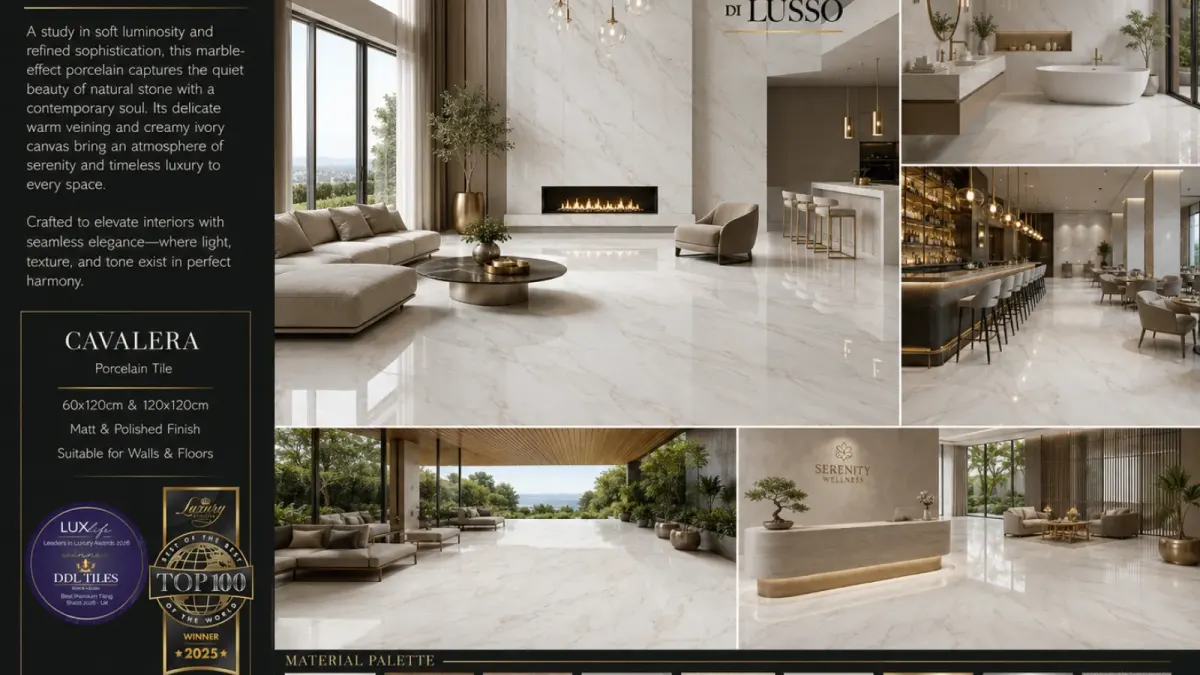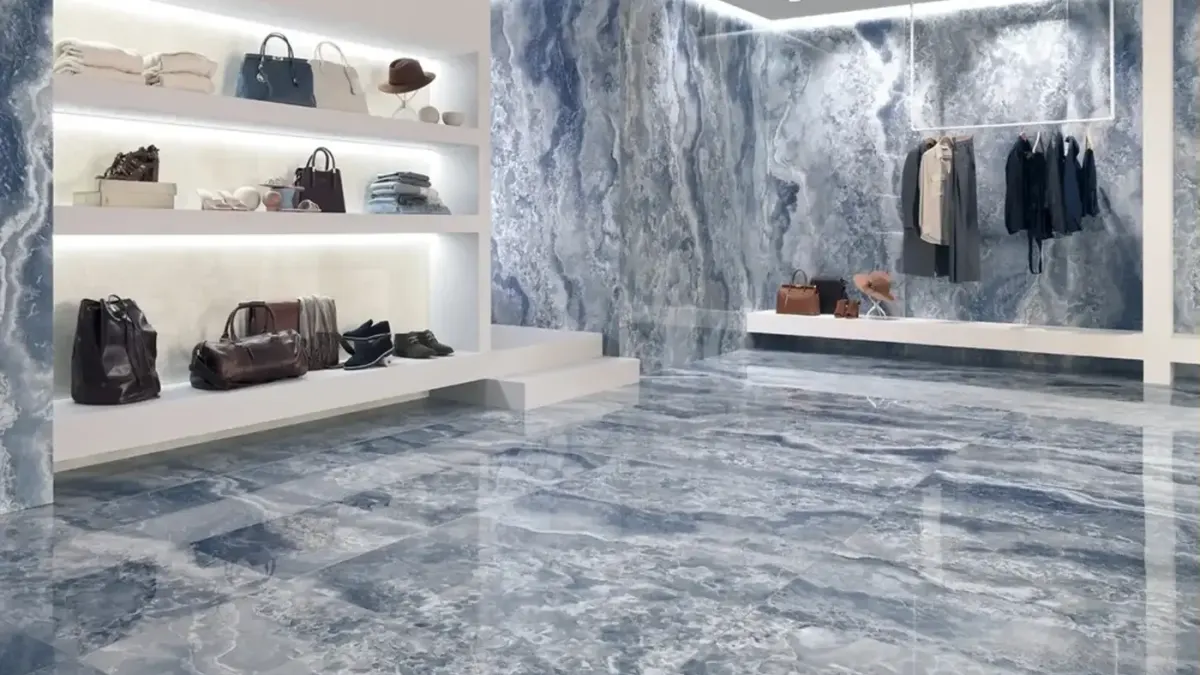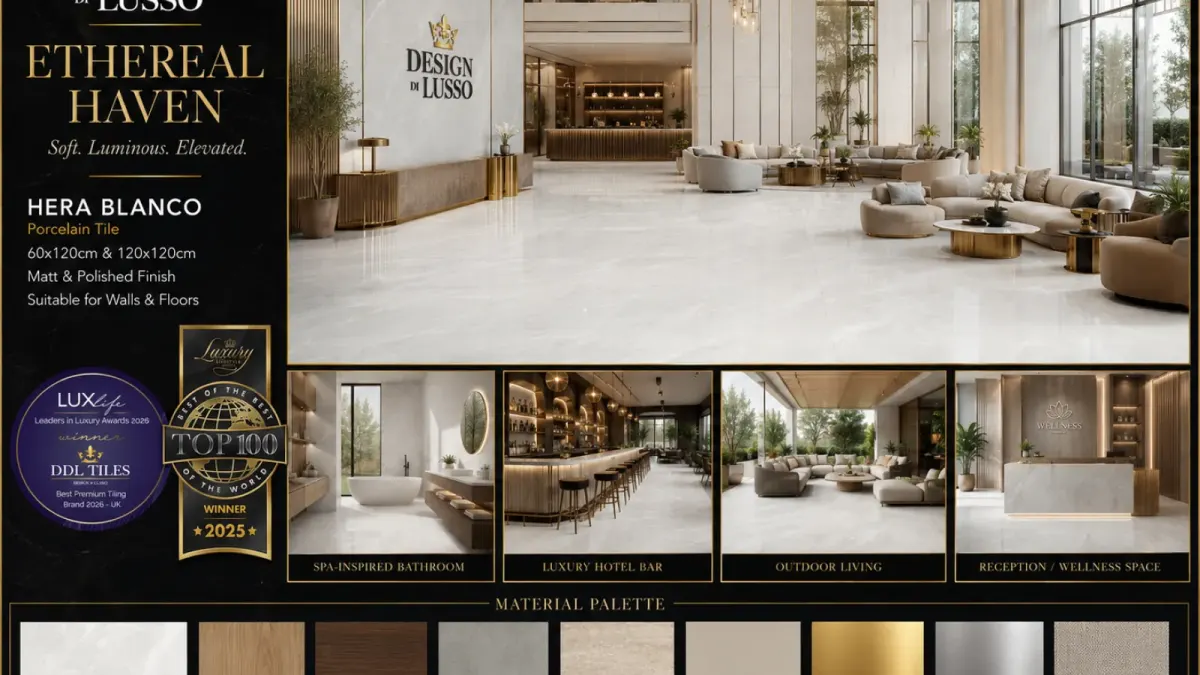
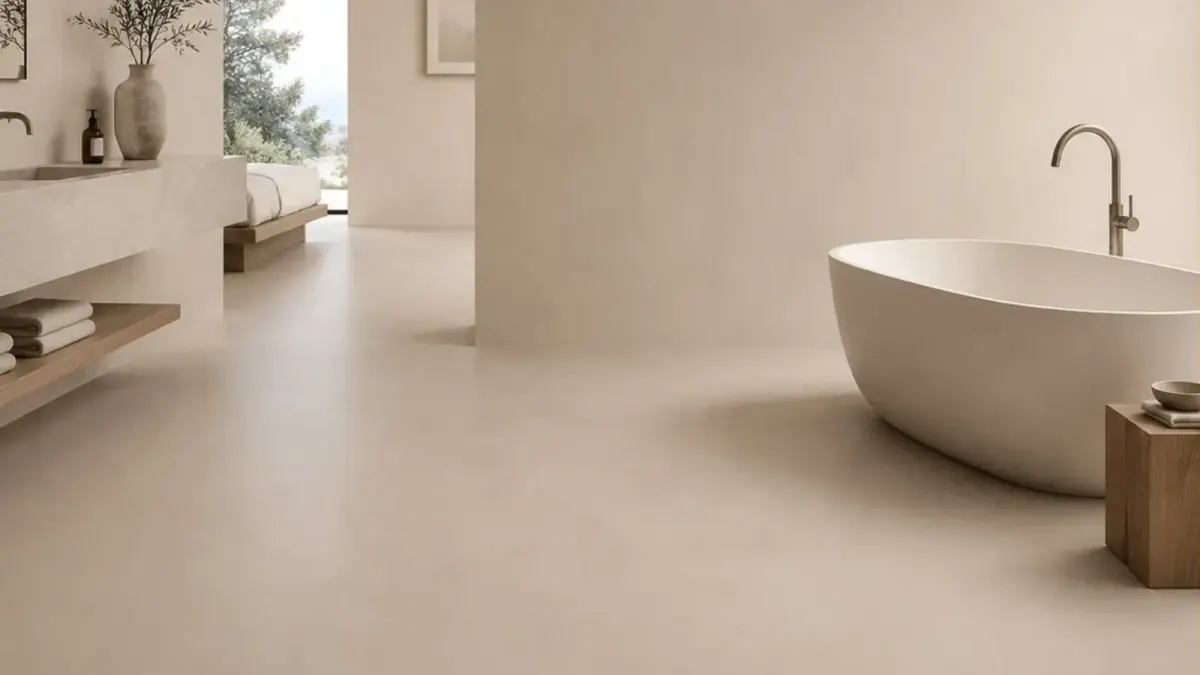
The complete guide to large format tiles and porcelain slabs: sizes, where they work, tiles vs slabs, installation, small rooms, cost bands and how to choose.
Large format tiles are tiles with at least one edge measuring 600mm or more, ranging from 600x1200mm and 1200x1200mm formats up to full porcelain slabs of 1600x3200mm, delivering a luxury stone look by dramatically reducing the number of grout lines across a wall or floor.
Because a single large tile covers the area of many smaller ones, you see continuous surface rather than a grid of joints, which is precisely why large format has become the signature of high-end bathrooms, kitchens and living spaces. Large format porcelain performs everywhere ordinary tile does (floors, walls, wet rooms, feature walls and even worktops in slab form) while resisting water, stains and scratches. The trade-off is that oversized tiles demand a flat substrate and genuinely skilled installation. Chosen and fitted well, they are the single most effective way to make a space read as considered, generous and expensive.
What this guide covers
This is the guide our design team wishes every client read before they started planning. Large format is Design Di Lusso's core specialism, and getting it right is far more than picking a big tile. Below we explain exactly what "large format" means, where the sizes work best, the real difference between tiles and slabs and when to choose each, the installation realities nobody warns you about, the persistent myth that large tiles shrink a small room, honest cost bands, how to choose like a designer, and the mistakes we see most often. Wherever a topic deserves a deeper dive, we link down to our focused articles so you can go further.
What does "large format" actually mean?
Large format is a description of scale, not a single fixed size. The generally accepted industry line is that a large format tile has at least one edge of 600mm or longer. In practice, though, the tiles that create the smooth designer look sit well above that threshold.
The current large format family runs roughly like this: 600x600mm and 600x1200mm are the everyday entry to large format; 1200x1200mm is a popular, well-proportioned floor and wall size; 1200x2400mm is the format that starts to read as genuinely architectural; and full porcelain slabs reach up to 1600x3200mm, the largest single pieces you can put on a wall or floor. Slabs are also produced in reduced thicknesses (around 6mm) specifically so they can be handled and even bonded over existing surfaces.
The reason the size matters so much is grout. A single 1200x2400mm tile covers the same area as sixteen 600x600mm tiles, which means one continuous surface where you would otherwise have dozens of joints. Fewer joints is the entire aesthetic argument for large format, and it is worth understanding before any other decision.
Rectified edges: why they matter for large format
Almost all quality large format porcelain is rectified, meaning each tile is mechanically ground to a precise, perfectly straight size after firing. Rectification is what allows large tiles to be laid with very thin grout lines (often 2mm or less) because the edges are true and consistent. Without rectified edges you cannot achieve the tight, near-invisible joints that make large format read as stone rather than tile. When you see a specification, "rectified" is not a luxury upgrade; for large format it is essential.
Why fewer grout lines is the whole point
Natural stone slabs arrive as single, jointless pieces, so the instinctive luxury signal our eyes read is continuity of surface. Large format porcelain chases that same signal. The more you reduce visible grout, the more the material reads as continuous stone and the more generous the room feels.
There is a practical dividend too. Grout lines are where limescale, grime and mould gather, so a large format bathroom or kitchen has far fewer places for dirt to collect and is genuinely easier to keep clean. On a heavily-used floor, fewer joints also means fewer weak points and a more uniform wearing surface.
The visual effect compounds with good design choices: thin, tonally-matched grout, a considered layout, and, on premium ranges, vein-matched or book-matched patterns that flow across the joints so the marble or stone effect continues uninterrupted from one tile to the next. Done properly, a large format wall stops looking tiled and starts looking carved from a single block of material.
Where large format tiles work best
One of the most common misconceptions is that large format is for floors only. In reality it excels across almost every surface in the home, and the material, porcelain, is what makes that versatility possible.
Floors. The original home of large format. Continuous, low-joint floors make rooms feel bigger and calmer, and porcelain shrugs off foot traffic, scratches and moisture.
Walls. Large format walls are transformative in bathrooms and kitchens. Full-height tiles behind a bath, in a shower or as a splashback read as solid stone. This is where large format most obviously elevates a space.
Wet rooms and showers. Because porcelain is virtually non-porous, large format is ideal for wet rooms: fewer grout lines mean fewer places for water to find, and the continuous look carries onto the shower floor when you specify the correct slip-rated finish.
Feature walls. A single book-matched slab behind a bath, bed or fireplace is one of the most striking things you can do with large format, delivering a symmetrical, gallery-like statement.
Worktops and vanity tops. In slab form, porcelain becomes a worktop material (heat, scratch and stain resistant) and can be matched to the floor and walls for a fully coordinated scheme.
Outdoor. Large format porcelain is produced in structural 20mm outdoor versions that can match a 10mm indoor tile from the same range, creating an uninterrupted indoor-outdoor flow.
If you want the fuller argument on whether the format earns its place, our detailed piece on whether large format tiles are worth it walks through the value case in depth.
Tiles vs slabs: what's the difference, and when to choose each
"Tile" and "slab" get used loosely, but the distinction matters when you are specifying a project. Both are porcelain; the difference is scale, thickness options and application.
| Large format tiles | Porcelain slabs | |
|---|---|---|
| Typical sizes | 600x1200mm, 1200x1200mm, 1200x2400mm | 1600x3200mm and similar oversized formats |
| Thickness options | Usually 9-12mm (plus 20mm outdoor) | 6mm, 12mm and 20mm variants |
| Best for | Floors, walls, wet rooms, most rooms | Feature walls, book-matching, worktops, overlay |
| Grout lines | Few | Almost none / single piece |
| Handling | Two-person, manageable on site | Specialist lifting frames and crew |
| Worktops | No (use slab) | Yes |
| Best use case | Whole-room schemes, everyday luxury | Statement surfaces and coordinated slab-to-worktop schemes |
Choose large format tiles for most projects: whole bathrooms, kitchen floors, living areas and wet rooms. They give you the continuous look with manageable handling and a wide choice of sizes and finishes.
Choose porcelain slabs when you want the ultimate statement or a specific technical result: a jointless book-matched feature wall, a run of worktop that matches the floor, or a 6mm slab bonded over an existing surface to avoid ripping everything out. Slabs cost more and demand specialist handling and fitting, but nothing else produces a truly single-piece surface.
For the drama of a mirrored feature, our guide to what book-matched tiles are explains exactly how the effect is created and where to use it.
The installation realities nobody warns you about
This is the section that saves projects. Large format is spectacular when fitted correctly and disappointing when it isn't, and almost every problem traces back to the same three issues: flatness, adhesive and handling. Large format is not a DIY or outlay-fit surface: the fitting is where the money and the skill go.
Substrate flatness is everything
A large, rigid tile cannot follow an uneven floor or wall. Where a small tile flexes over minor undulations, a 1200x2400mm tile bridges them, and any dip or hump shows immediately as lippage: one tile edge sitting proud of its neighbour. The industry standard for large format is a substrate flat to within 3mm over a 2-metre span. Achieving that often means self-levelling compound on floors and skimming or battening out walls before a single tile is laid. Preparation is not optional; it is most of the job.
Adhesive and the full-contact rule
Large format must be laid with the correct adhesive and technique. The rule is full coverage: no voids beneath the tile, because any hollow spot under a large rigid tile becomes a crack point under load. Fitters use a large-notched trowel and often back-butter each tile (spreading adhesive on the tile as well as the substrate) to guarantee full contact. A rapid-set, flexible S1 or S2 adhesive is standard. This is skilled work with specific materials, not a job for general-purpose tile cement.
Handling, lippage and levelling systems
A single large format tile is heavy and, on slabs, requires suction lifting frames and a trained crew simply to move without cracking it. During laying, professional fitters use tile levelling systems (clips and wedges that hold adjacent tiles perfectly flush while the adhesive cures) to eliminate lippage. Cutting is done with rail cutters or water-fed bridge saws because porcelain is extremely hard. None of this is a reason to avoid large format; it is the reason to allow for genuinely experienced installation. The finished result is entirely dependent on the fit.
The small-room myth: do large tiles make a small room look smaller?
This is the single most common worry we hear, and it is backed by an old, incorrect rule of thumb. The instinct says small room, small tiles. The reality is the opposite: large format tiles make small rooms look bigger, not smaller.
The reason is grout lines. A small room tiled in small tiles is covered in a dense grid of joints, and that grid visually chops the space into busy little segments, drawing attention to how compact it is. Large tiles remove most of those joints. With fewer lines to interrupt the eye, the surface reads as continuous and the boundaries of the room feel further away. A large tile also means fewer cuts around the edges, which keeps the layout clean and deliberate.
The practical caveat is proportion and layout: in a very small ensuite you match the tile size sensibly to the room and plan the setting-out so you avoid thin sliver cuts in corners. But the fear that big tiles shrink a small bathroom is simply wrong. Our dedicated guide to the best tile size for a small bathroom gives the full setting-out logic.
How much do large format tiles and slabs cost?
Pricing depends on size, finish, thickness, effect and, significantly, installation, but the honest picture is this: large format porcelain sits firmly in the premium tile bracket, and porcelain slabs sit above it, with skilled fitting a meaningful part of the total. Treat the numbers below as indicative UK supply bands per square metre, before fitting.
| Format / type | Indicative supply band (per m²) | Notes |
|---|---|---|
| 600x1200mm rectified porcelain | £ mid band | Entry to large format, wide choice |
| 1200x1200mm / 1200x2400mm | £ upper-mid band | The signature designer sizes |
| Book-matched / vein-matched ranges | £ premium band | Sold as matched pairs/sets |
| 1600x3200mm porcelain slabs | £ top band | Specialist handling and fitting |
| 20mm outdoor large format | £ premium band | Structural, for external use |
Two points matter more than the headline rate. First, installation is not the place to economise: large format demands substrate preparation, the right adhesives, levelling systems and an experienced crew, and this labour is a real and worthwhile line in the outlay. Second, think in total cost of ownership: porcelain never needs sealing, resists stains and scratches, and lasts for decades, so the lifetime spend is low relative to natural stone. Our design team can give accurate, project-specific pricing once we understand your area, chosen range and format.
How to choose large format tiles like a designer
Choosing well is a sequence of considered decisions, not a single pick. Here is the order our team works through with clients.
- Start with the effect. Marble, stone, concrete, terrazzo or wood: the look sets the whole scheme. Marble and stone effects are the most requested for luxury interiors.
- Match size to space and surface. Larger formats read most luxurious, but the size must suit the room's proportions and the practicality of getting tiles into the space.
- Specify rectified for thin joints. Non-negotiable for the continuous look.
- Match finish to location. Polished or gloss on walls; slip-rated matt or textured (R10+, R11 for wet floors) on any floor that gets wet.
- Decide tiles vs slabs per surface. Tiles for most areas; slabs for feature walls, worktops and book-matching.
- Coordinate across the range. Many premium ranges offer matching floor, wall, slab and outdoor versions of the same effect, letting you flow one material through a whole home.
- See it at full scale. A sample cannot show you how veining reads across a 2.4-metre tile under your lighting.
For coordinating a marble scheme in particular, our marble-effect tiles collection pairs naturally with large format specification.
The most common large format mistakes
Honesty serves clients better than hype, so here are the errors we most often correct.
- Skimping on the fit. The commonest and costliest mistake. Large format on an unprepared substrate or with the wrong adhesive produces lippage, hollow spots and cracked tiles. Allow for skilled installation from the start.
- Ignoring substrate flatness. Assuming an old floor or wall is flat enough. It rarely is. Preparation is most of the job.
- Choosing polished porcelain for a wet floor. Beautiful on walls, unsafe underfoot when wet. Match finish to location.
- Buying non-rectified tiles for a continuous look. Without rectified edges you cannot achieve thin, tight joints, and the tile reads as tile.
- Thick, contrasting grout. A dark grid across large tiles reintroduces exactly the busy look large format is meant to remove. Keep grout thin and tonal.
- Underestimating access. A 1600x3200mm slab has to physically get into the room. Plan delivery and access before ordering.
- Poor setting-out. Starting a layout without planning the cuts leaves ugly slivers in corners. Set out from the centre and the sightlines.
Frequently asked questions
What size is considered a large format tile?
A large format tile has at least one edge measuring 600mm or longer. In practice the sizes that create the smooth designer look are larger still: 600x1200mm, 1200x1200mm and 1200x2400mm are common, while full porcelain slabs reach up to 1600x3200mm. The larger the format, the fewer grout lines and the more continuous the surface appears.
Are large format tiles good for small bathrooms?
Yes. Contrary to the old rule of thumb, large format tiles make a small bathroom look bigger by removing the dense grid of grout lines that visually chops up a compact space. Fewer joints mean the surface reads as continuous and the room feels more generous. The key is sensible setting-out to avoid thin sliver cuts in corners.
What's the difference between a large format tile and a porcelain slab?
Both are porcelain. Large format tiles run up to around 1200x2400mm and suit floors, walls and wet rooms across whole schemes. Porcelain slabs reach up to 1600x3200mm, come in 6mm, 12mm and 20mm thicknesses, and are used for single-piece feature walls, book-matching, worktops and overlaying existing surfaces. Slabs cost more and need specialist handling.
Do large format tiles need a special installation?
Yes. Large format requires a substrate flat to within 3mm over 2 metres, full-coverage adhesive (often with back-buttering), a flexible rapid-set adhesive, tile levelling systems to prevent lippage, and experienced fitters. Oversized tiles cannot follow an uneven surface, so preparation and skilled installation are essential rather than optional.
Are large format tiles more expensive?
Large format porcelain sits in the premium tile bracket and slabs sit above it, with skilled installation a meaningful part of the total cost. However, porcelain never needs sealing, resists stains and scratches, and lasts for decades, so the lifetime cost is low. The continuous look and easy maintenance make it a strong long-term investment.
Can large format tiles be used on walls?
Absolutely: walls are one of the most transformative uses. Full-height large format behind a bath, in a shower or as a splashback reads as solid stone and elevates the whole room. Because porcelain is light relative to natural stone and produced in reduced thicknesses, large tiles and even slabs can be wall-mounted with the correct adhesive and preparation.
What are book-matched slabs?
Book-matched slabs are porcelain slabs cut in mirrored pairs from the same printed vein sequence, so the pattern opens symmetrically like a butterfly's wings when the two pieces are laid side by side. The effect, once possible only with natural stone, creates a dramatic, gallery-like feature wall and is one of the most luxurious uses of porcelain.
Are large format tiles slippery?
Only if you specify the wrong finish for the surface. Polished and gloss finishes belong on walls, where slip is irrelevant. For any floor that gets wet, specify a slip-rated matt or textured finish: R10 or above for bathroom floors, R11 for wet rooms and shower floors. Matching a polished wall to a matt floor in the same effect keeps the look cohesive and safe.
Bring the finished look into your home
Large format tiles and porcelain slabs are the most effective way to make a space read as luxurious, generous and considered, but the material, the size, the finish and above all the installation have to be right. Get those decisions in the correct order and you end up with surfaces that look carved from single blocks of stone and last for decades with almost no maintenance. Get them wrong and the format's advantages disappear. That sequence of judgement is exactly what our design team exists to guide you through, whether you are a homeowner planning one statement room or an architect specifying across a whole project.
See large format tiles and slabs at our Watford showroom
Large format is a material you have to experience at full scale: a sample can never show you how veining flows across a 2.4-metre tile, how a book-matched slab opens, or how polished and matt finishes catch your light. Visit our 7,000 sq ft showroom in Watford to see large format tiles and full porcelain slabs displayed at scale, compare sizes and effects under proper lighting, and plan your scheme with our award-winning design team. As effect-porcelain specialists, we will help you specify large format the way it is meant to be used.
Book your free consultation at our Watford showroom →
Design Di Lusso (DDL Tiles), Watford, Luxury Lifestyle Awards, Top 100 Best of the Best 2025. Explore our large-format tiles and marble-effect tiles, and read more on whether large format tiles are worth it.