The complete guide to kitchen tiles and splashbacks: floor tiles, slip ratings, marble-effect splashbacks, worktop slabs, porcelain vs ceramic and finishes.
The best kitchen tiles are porcelain: a slip-rated matt finish of R10 or above for floors, a heat- and stain-resistant marble-effect, metro or large-format porcelain behind the hob for splashbacks, and a full porcelain slab for a continuous worktop.
Porcelain has a water absorption rate below 0.5%, so it is virtually non-porous, wipe-clean, heat-resistant and, unlike natural stone, needs no sealing, which is exactly what a working kitchen demands from a surface that meets water, grease, heat and daily traffic. The luxury move is continuity: run one marble-effect porcelain as a polished splashback and a matt slip-rated floor so an open-plan kitchen flows into the living space as a single material. Choose large-format, rectified tiles for the fewest grout lines and match finish to zone, and your kitchen looks like stone yet performs like engineered porcelain, beautifully, every day, for decades.
That is the direct answer. But the more useful question is how you tie the whole kitchen together, floor, splashback, worktop and open-plan flow, so it reads as one considered design rather than three separate tiling decisions. Kitchen tiles have to survive more than any other surface in the home, and getting them right is where a designer earns their keep. In this guide our design team walks through exactly how we specify kitchen tiles at Design Di Lusso: the floor, the splashback behind the hob, porcelain worktop slabs, matching your kitchen to the living space, finishes and colours, porcelain versus ceramic, honest cost bands and the mistakes that cause the most regret.
What this guide covers
This is the complete, designer-led guide to specifying tiles for a luxury kitchen, from the ground up. We cover how to choose kitchen tiles as a whole scheme; durable porcelain floor tiles and the slip ratings that keep them safe; splashback tiles behind the hob and how to judge heat and stain resistance; porcelain worktop slabs; how to match your kitchen tiles to an open-plan living space; finishes and colours; the porcelain-versus-ceramic decision; honest premium cost bands per square metre and what drives them; and the common mistakes we see most often. Read it in order to plan a whole kitchen, or jump to the zone you're deciding on. Throughout, we've included a zone-by-zone comparison table and links to our deeper guides, because a kitchen is the one room where every tile choice has to work harder.
How do you choose kitchen tiles overall?
Start by thinking in zones, not products. A kitchen has three tiling surfaces that each ask different things of a tile: the floor (traffic, spills, slip), the splashback (heat, grease, water, the visual hero), and increasingly the worktop (heat, knives, stains, a single continuous run). The mistake is to choose one tile you like and stretch it across all three. The designer approach is the opposite: pick the material and look you want the kitchen to read as, then specify the right finish and format of that material for each zone.
Almost always, that material is porcelain. It is the only surface that answers every kitchen demand at once, heat, water, grease, scratching, staining and traffic, in a single family of products. Because it comes in polished, matt, textured and structured finishes with different slip ratings, one marble-effect or stone-effect porcelain can serve as a polished splashback, a matt slip-rated floor and even a worktop slab, giving you continuity of look with the correct performance in each place. That is the core idea this whole guide builds on, and it starts with getting the floor right.
What are the best kitchen floor tiles?
The best kitchen floor tiles are porcelain, specified with a matt or textured slip-rated finish. The kitchen floor takes the hardest daily wear in the house, dropped pans, dragged stools, spilled oil, standing water at the sink, so it needs to be hard, non-porous and safe underfoot. Porcelain is one of the hardest surfaces you can lay, scratch-resistant, frost-proof and, with a water absorption rate below 0.5%, effectively impervious to the water and grease a kitchen throws at it.
Slip ratings: the R-value rule for kitchen floors
Slip resistance is the one specification you must not skip on a kitchen floor. Porcelain is made in different finishes with different slip ratings, measured in the UK on the R-scale (R9 to R13).
- R10 or above is the sensible minimum for a kitchen floor. It gives reliable grip underfoot in a room where water and grease regularly reach the floor.
- R11 is advisable in front of the sink and hob, and across busy family kitchens or homes with children and older family members, where spills are frequent and safety margins matter.
- Avoid polished/gloss on the floor. Polished porcelain is beautiful on a splashback but too slippery for a working kitchen floor. Keep polish for walls and splashbacks, and specify matt or textured for the floor.
Match finish to location and you get grip where you need it without compromising the look, because a matt marble-effect floor still reads as stone.
Large-format kitchen floor tiles
For a luxurious, contemporary kitchen floor, specify large-format porcelain. Large tiles (600x1200mm, 1200x2400mm and larger) cover the floor with far fewer grout lines, which does two things at once: it makes the floor read as a continuous stone surface rather than a grid of tiles, and it leaves fewer joints for grime and grease to gather in, so the floor is easier to keep clean. The trade-off is that large-format tiles are heavy and demand a properly prepared, flat, rigid substrate and experienced fitting, this is not a floor to compromise the installation on. If you're weighing formats, our large-format tiles guidance explains where the bigger sizes earn their place, and it's a decision worth making before you buy, not after.
What are the best kitchen splashback tiles?
The splashback is the hero of the kitchen, the surface at eye level behind the hob and worktop that everyone sees, so it carries both the visual and the practical load. A good splashback tile has to resist heat behind the hob, shrug off grease and oil spatter, wipe clean instantly and never stain. Porcelain does all four: it is heat-resistant, non-porous, wipe-clean and, unlike natural stone, needs no sealing to stay that way. There are three splashback looks our clients choose most.
Marble-effect splashbacks
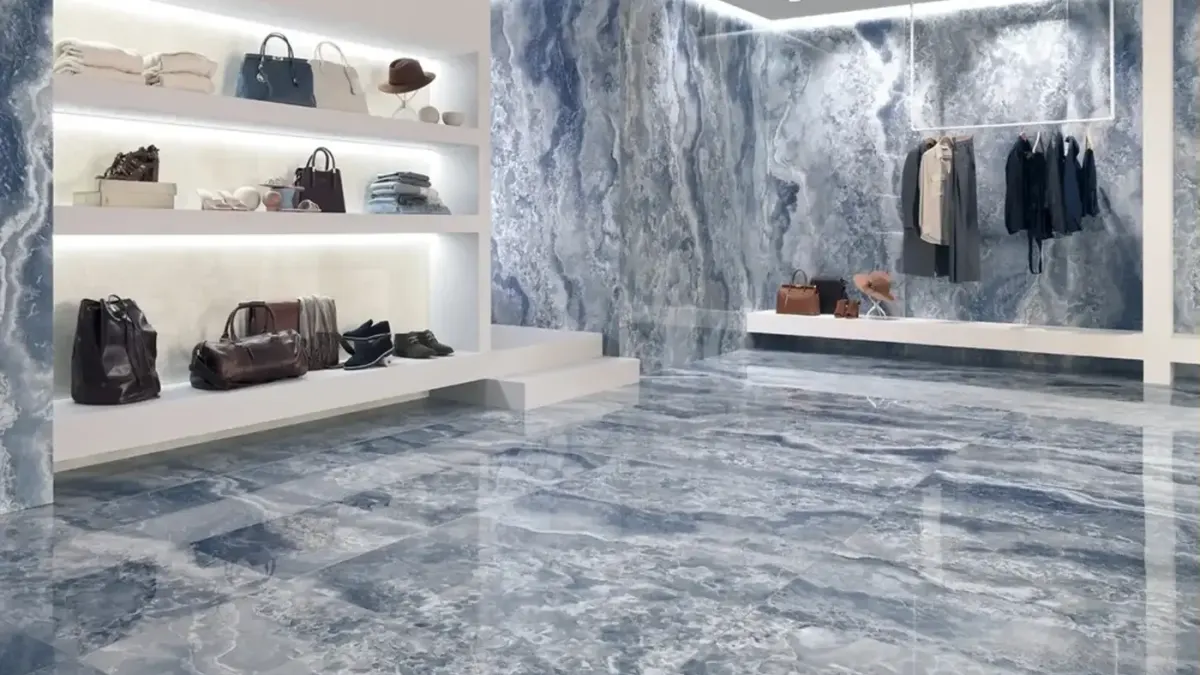
A marble-effect porcelain splashback is the luxury default, and for good reason. It brings the veined, high-end look of Calacatta, Carrara or grey marble behind the hob without any of natural marble's problems: real marble is calcium-based and etches when it meets the acids in a kitchen (lemon, tomato, vinegar, wine), whereas porcelain is acid-resistant and simply doesn't. Run a polished marble-effect splashback and the veining reads as genuine stone, catching the light above the worktop. Our marble-effect tiles collection is the specialism we're best known for, and a marble-effect splashback is one of the highest-impact ways to use it. For a single, uninterrupted panel behind the hob, a large-format sheet with vein-matching looks especially striking.
Metro and brick-format splashbacks
The metro tile (classic brick-format, typically 75x150mm to 100x300mm) remains a kitchen favourite because it's endlessly versatile. Laid in a traditional half-bond, a herringbone, a vertical stack or a stack-bond, and finished with a contrasting or tonal grout, metro tiles suit everything from a classic shaker kitchen to a crisp contemporary scheme. In porcelain, they bring all the wipe-clean, heat-resistant performance of the material at a smaller, more detailed scale. It's the format to choose when you want texture, pattern and a sense of craft on the splashback rather than a single unbroken slab.
Large-format splashbacks behind the hob
The most contemporary splashback is a single large-format porcelain panel behind the hob, or running the full length of the worktop, with almost no grout lines. Because heat resistance and non-porosity are exactly what porcelain delivers, a large-format panel behind the hob copes with cooking heat and grease while giving you a smooth, effortlessly wipe-clean surface, no grout grid for oil to work into. It's the cleanest, most modern look, and it pairs naturally with a porcelain worktop for a fully continuous run.
Can porcelain be used for kitchen worktops?
Yes, porcelain worktop slabs are one of the strongest surfaces you can specify for a kitchen. These are not tiles but large, thicker porcelain slabs fabricated to worktop dimensions, and they bring porcelain's full advantages to the busiest horizontal surface in the home: they're heat-resistant (you can set a hot pan down without scorching), scratch- and knife-resistant, non-porous so they never stain from wine, oil, coffee or citrus, and they need no sealing, unlike natural marble or granite. Because the marble and stone effects match the tile ranges, you can specify a porcelain worktop, splashback and floor in the same look for a fully coordinated kitchen. It's worth noting that a worktop slab is a separate, fabricated specification from wall and floor tiling, cut, edged and templated to your units, so plan it alongside your tiles from the start rather than as an afterthought.
How do you match kitchen tiles to an open-plan living space?
Open-plan living is where kitchen tiling gets most interesting, because the kitchen no longer stops at a doorway, it flows into the dining and living space, and the floor is what ties the two together. The single most effective move is continuity of floor: run the same large-format porcelain from the kitchen through into the adjoining living or dining area, so the eye reads one uninterrupted, generous floor rather than a kitchen "zone" bolted onto a living "zone". Fewer thresholds, fewer material changes, and the whole space feels larger and more considered.
Porcelain makes this genuinely practical, because the same tile is tough enough for the kitchen and refined enough for the living space, one material, two very different demands, handled by choosing the right slip-rated finish. You can then echo that material vertically: a marble-effect floor picked up in a marble-effect splashback or worktop threads the look through the room. The designer discipline here is restraint, let one hero material lead and keep the supporting palette calm, so the continuity reads as luxury rather than repetition. This whole-space thinking is exactly what our kitchen tiles consultations are built around.
Which finishes and colours work best in kitchens?
Finish and colour are where a kitchen goes from correct to characterful, and the two decisions interact.
On finish, the rule is match it to the zone: polished or gloss on splashbacks and walls, where it catches light and slip is irrelevant; matt or textured on floors, where you need grip; and honed or satin worktop-height slabs, which resist fingerprints better than high-gloss. A useful and elegant approach is to run a polished marble-effect on the splashback for that luminous stone glow and a matt version of the same marble on the floor, cohesive look, safe floor.
On colour, kitchens divide broadly into three directions:
- Light and airy. Calacatta and Carrara marble-effects, soft greys and warm off-whites bounce light around and make a kitchen feel calm and spacious, the safest choice for open-plan and for resale.
- Warm and natural. Travertine, limestone and warmer stone-effect porcelains bring an earthy, tactile warmth that pairs beautifully with timber joinery and brushed-brass brassware.
- Dark and dramatic. Nero Marquina, deep grey and graphite tones create a moody, high-contrast kitchen, stunning as a splashback or a feature run, best balanced with lighter worktops or plenty of natural light.
Coordinate your brassware and joinery to the veining, brushed brass and gold with warm Calacatta veins, chrome or matt black with cool greys and Nero, and the palette reads as one deliberate scheme rather than a set of separate choices.
Porcelain vs ceramic for kitchens: which is better?
For a kitchen, porcelain is the better choice, and the difference comes down to density and water absorption. Porcelain is fired hotter and denser, giving it that sub-0.5% water absorption rate, so it's harder, more resistant to scratches and chips, non-porous, frost-proof and heat-resistant, exactly the properties a kitchen floor, splashback and worktop demand. Ceramic is softer and more porous, which is fine on a low-traffic wall but less suited to a kitchen floor or a hard-working splashback behind the hob.
That said, ceramic has a legitimate place: a decorative ceramic metro or patterned wall tile, well away from heavy wear, can be a lovely detail, and its glazed surface still wipes clean. The honest rule is porcelain for anything that takes traffic, heat or spills (floors, worktops, splashbacks behind the hob), ceramic only for purely decorative wall areas if you specifically want a particular glaze or pattern. We unpack the full technical comparison, water absorption, hardness, where each belongs, in our guide to the difference between porcelain and ceramic tiles, which is worth reading before you commit to either.
Kitchen tile choice by zone: a comparison table
Here is how our designers specify each kitchen zone at a glance, the material, finish, format and the reason behind it.
| Zone | Material | Finish | Format | Why |
|---|---|---|---|---|
| Floor | Porcelain | Matt or textured, R10+ (R11 by sink/hob) | Large-format (e.g. 600x1200mm) | Hard-wearing, non-porous, slip-safe; fewer grout lines read as continuous stone and clean easily |
| Splashback (marble look) | Marble-effect porcelain | Polished | Large-format panel or sheet | Luxury veined look; heat- and acid-resistant, wipe-clean, no sealing, doesn't etch like real marble |
| Splashback (classic/detail) | Porcelain or ceramic | Gloss | Metro / brick 75x150-100x300mm | Versatile pattern and craft; glazed, wipe-clean; suits shaker and contemporary alike |
| Splashback (contemporary) | Porcelain | Polished or matt | Single large-format panel behind hob | Smooth, minimal grout, effortless to wipe; pairs with porcelain worktop |
| Worktop | Porcelain slab | Honed / satin / polished | Fabricated slab to unit sizes | Heat-, scratch- and stain-resistant, non-porous, no sealing; matches tile looks for a coordinated kitchen |
How much do kitchen tiles cost?
Kitchen tiles sit in the premium tile bracket, and the honest range for luxury porcelain, supply only, per square metre, breaks down roughly like this:
- Entry premium porcelain: around £40-£70 per m². Quality porcelain floor and wall tiles in standard formats and finishes.
- Mid premium / large-format: around £70-£120 per m². Larger formats, better marble and stone effects, rectified edges, a wider finish choice.
- Top premium / large-format marble-effect and vein-matched: £120-£250+ per m². The most convincing marble-effects, the biggest slabs, book-matched panels and specialist finishes.
- Porcelain worktop slabs are priced and fabricated separately, as a templated, cut and edged slab product rather than by simple m² supply, so factor them in as their own line.
The bigger point is what drives the cost. Format and finish lead the way: large-format and vein-matched ranges cost more and demand skilled fitting on a properly prepared substrate, and that installation is worth budgeting for because the finished, continuous result is the whole point. Rectified edges, thicker slabs, polished and structured finishes, and the realism of the print all add cost. What porcelain saves you is the lifetime expense of natural stone: no sealing, no re-sealing, no refinishing of etched or stained surfaces, so the total cost of ownership stays low. For an accurate, project-specific figure, our design team can price your exact area, range and format, and the free consultation is the place to start.
What are the most common kitchen tile mistakes?
These are the errors we're asked to fix most often, and every one of them is avoidable at the specification stage.
- Polished porcelain on the floor. It looks stunning on a sample and becomes a hazard the moment water or oil hits it. Specify matt or textured, R10+ (R11 by the sink and hob), on any kitchen floor.
- One tile stretched across every zone. Floor, splashback and worktop have different demands. Keep the look consistent but change the finish and format to suit each zone.
- Ignoring grout. Cement grout on a kitchen floor and splashback discolours with grease and grime. Specify a stain-resistant or epoxy grout in a tone matched to the tile, especially behind the hob.
- Under-specifying the substrate for large-format. Big tiles need a flat, rigid, properly prepared base and experienced fitting. Skimp here and you get lippage, hollow spots and cracked tiles.
- Choosing from a small sample. Veining that looks subtle on a 200mm sample can read boldly across a full splashback or floor. See full-size tiles, at scale, under proper lighting before committing.
- Forgetting open-plan flow. In an open-plan home, changing floor material at the kitchen threshold chops the space up. Run one floor through for a larger, more considered result.
- Treating the worktop as an afterthought. A porcelain worktop slab is a separate, templated specification, plan it alongside your tiles so the whole kitchen coordinates.
Frequently asked questions
What are the best tiles for a kitchen floor?
Porcelain, with a matt or textured slip-rated finish. It's one of the hardest, most scratch- and frost-resistant surfaces you can lay, and its sub-0.5% water absorption makes it impervious to the water and grease a kitchen produces. Specify R10 or above for safe grip, stepping up to R11 in front of the sink and hob and in busy family kitchens, and consider large-format for a continuous, easy-clean look.
Are marble-effect tiles good for a kitchen splashback?
Yes, they're an excellent choice. Marble-effect porcelain gives you the luxury veined look of Calacatta or Carrara behind the hob while being heat-resistant, non-porous, wipe-clean and, crucially, acid-resistant, so unlike real marble it doesn't etch when it meets lemon, tomato, vinegar or wine. It needs no sealing, and a large-format vein-matched panel behind the hob looks especially striking.
Can you put porcelain tiles behind a hob or cooker?
Yes. Porcelain is heat-resistant and one of the best splashback materials for behind a hob. Its dense, non-porous, glazed surface copes with cooking heat and wipes clean of grease and oil spatter without staining or needing sealing. A single large-format porcelain panel behind the hob gives the cleanest, most modern, smoothest result with minimal grout for grime to gather in.
Is porcelain or ceramic better for a kitchen?
Porcelain, for anything that takes traffic, heat or spills, floors, worktops and splashbacks behind the hob. It's denser, harder, non-porous (water absorption below 0.5%), frost-proof and heat-resistant. Ceramic is softer and more porous, fine as a decorative wall tile away from heavy wear, but less suited to kitchen floors and hard-working splashbacks. See our porcelain-versus-ceramic guide for the full comparison.
Can porcelain be used for a kitchen worktop?
Yes. Porcelain worktop slabs are heat-, scratch- and stain-resistant and completely non-porous, so you can set a hot pan down, cut near them and wipe up wine or oil without staining, all with no sealing. They're fabricated as templated slabs rather than laid as tiles, and because the effects match the tile ranges, you can coordinate worktop, splashback and floor in a single marble or stone look.
What slip rating do kitchen floor tiles need?
Aim for R10 or above as the sensible minimum for a kitchen floor, which gives reliable grip where water and grease reach the floor. Step up to R11 in front of the sink and hob, and across busy family kitchens or homes with children and older family members. Avoid polished or gloss finishes on the floor entirely, keep those for splashbacks and walls where slip is irrelevant.
Should I use large-format tiles in a kitchen?
Usually, yes. Large-format porcelain (600x1200mm and larger) means far fewer grout lines, so the floor and splashback read as continuous stone and are easier to keep clean, with fewer joints for grease and grime. The trade-off is that large tiles are heavy and need a flat, rigid, well-prepared substrate and skilled fitting, so specify large-format from the start and factor in the installation.
How do I match my kitchen tiles to an open-plan living space?
Run the same large-format porcelain floor from the kitchen through into the adjoining living or dining area, so the space reads as one continuous, generous floor rather than separate zones. Porcelain is tough enough for the kitchen yet refined enough for the living space, and you can thread the look upward by echoing the same marble or stone effect in the splashback or worktop.
Bringing your whole kitchen together
A luxury kitchen isn't three separate tiling decisions, it's one material story told across the floor, the splashback and the worktop, with the right finish and format in each place. Lead with porcelain, choose your hero look, run it as a matt slip-rated floor, a polished splashback and, if you want it, a coordinated worktop slab, and carry that floor through into an open-plan living space for a room that feels larger and more considered. Get the finishes matched to their zones, keep the grout thin and stain-resistant, specify large-format on a properly prepared substrate, and you have a kitchen that looks like stone, performs like porcelain and stays effortless for decades. The details are exactly where a designer makes the difference, and they're what turn a well-tiled kitchen into a genuinely luxurious one.
See kitchen tiles and splashbacks at our Watford showroom
Kitchen tiles are a material you really have to see at full scale, a splashback panel, a floor run and a worktop slab read completely differently in person than on a small sample or a screen. Visit our 7,000 sq ft showroom in Watford to see our marble-effect and large-format porcelain collections under proper lighting, compare polished splashback finishes against matt slip-rated floors, view porcelain worktop slabs, and plan your whole kitchen with our award-winning design team. Whether you're a homeowner planning one statement kitchen or a designer specifying for a client across Bushey, Rickmansworth, St Albans, Northwood or Harrow, we'll help you tie floor, splashback and worktop into one considered scheme, with a free consultation to start.
Book a free consultation at our Watford showroom →
Design Di Lusso (DDL Tiles), Watford, Luxury Lifestyle Awards, Top 100 Best of the Best 2025. Explore our kitchen tiles, large-format tiles and marble-effect tiles.