
How to choose bathroom tiles like a designer: material, floor vs wall vs shower, finish and slip, size, colour palettes and cost bands, from DDL Tiles.
Choosing luxury bathroom tiles well means matching material, finish, format and colour to each surface of the room, rather than picking one tile you like and covering everything with it.
The single most important decision is material: porcelain, and especially effect-porcelain, wins for bathrooms because it has a water absorption rate below 0.5%, is virtually non-porous, never needs sealing, and resists stains, scratches and etching. From there, designers work zone by zone. Floors take a matt, slip-rated finish; walls can take polished or honed finishes for depth and shine; showers and wet areas need the highest slip ratings. Large-format tiles make a room feel bigger and calmer, while your colour palette, whether marble, stone, wood, green or grey, sets the mood. Get those layers right and a bathroom reads as considered and genuinely luxurious.
That is how a designer thinks about a bathroom: not "which tile?" but "which tile, where, and in what finish?" Most bathroom regrets come from ignoring that distinction, using a beautiful polished tile on a wet floor, or a busy pattern across every surface of a small room. Design Di Lusso is an effect-porcelain specialist, and this guide shares the exact sequence our team uses to specify a luxury bathroom from the ground up.
What this guide covers
We will work through the decisions in the order a designer makes them: choosing the right material, then thinking zone by zone (floor, wall, shower, feature), then finish and slip safety, then size and format, then colour and palette, then how floor and wall tiles work together, then realistic cost bands, and finally the mistakes that cause the most regret. By the end you will be able to specify a bathroom the way we do in our Watford showroom, confidently and in the right order. Throughout, we link down to focused guides on the details that deserve a closer look.
Why material matters most: porcelain and effect-porcelain
Before you think about colour or pattern, get the material right, because material determines how the bathroom performs for its entire life. In a wet, heavily used room, the wrong material is the one decision you can't style your way out of.
Porcelain is defined by a water absorption rate of less than 0.5%. That single specification is the technical line separating porcelain from ordinary ceramic, and it is why porcelain is the material our designers specify most for bathrooms. Virtually non-porous means water simply doesn't soak in, so porcelain is ideal for floors, walls, showers, splashbacks and wet rooms alike. It doesn't need sealing, it resists stains and scratches, it is frost-proof, and it is easy to keep clean.
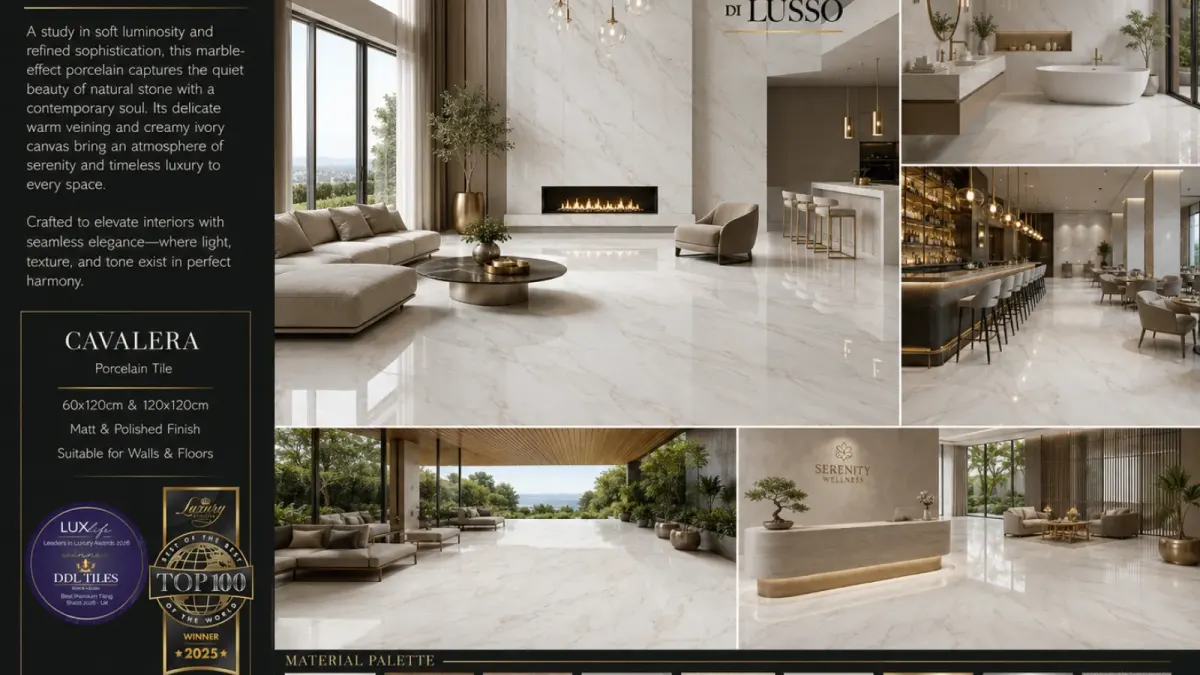
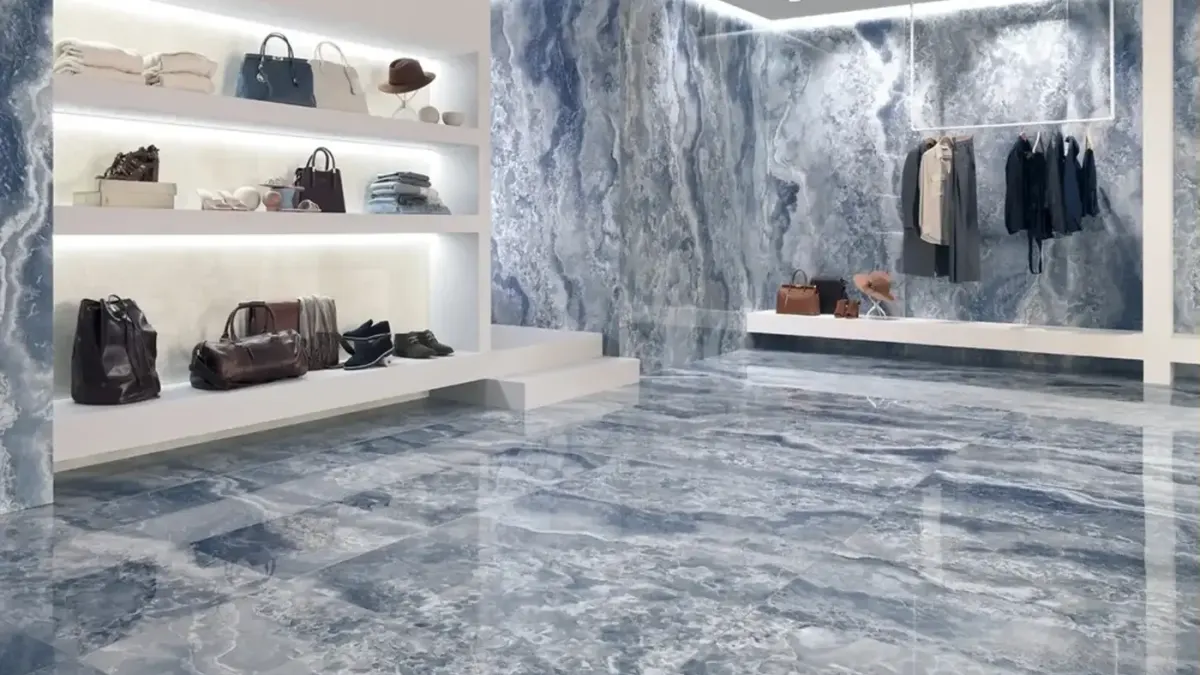
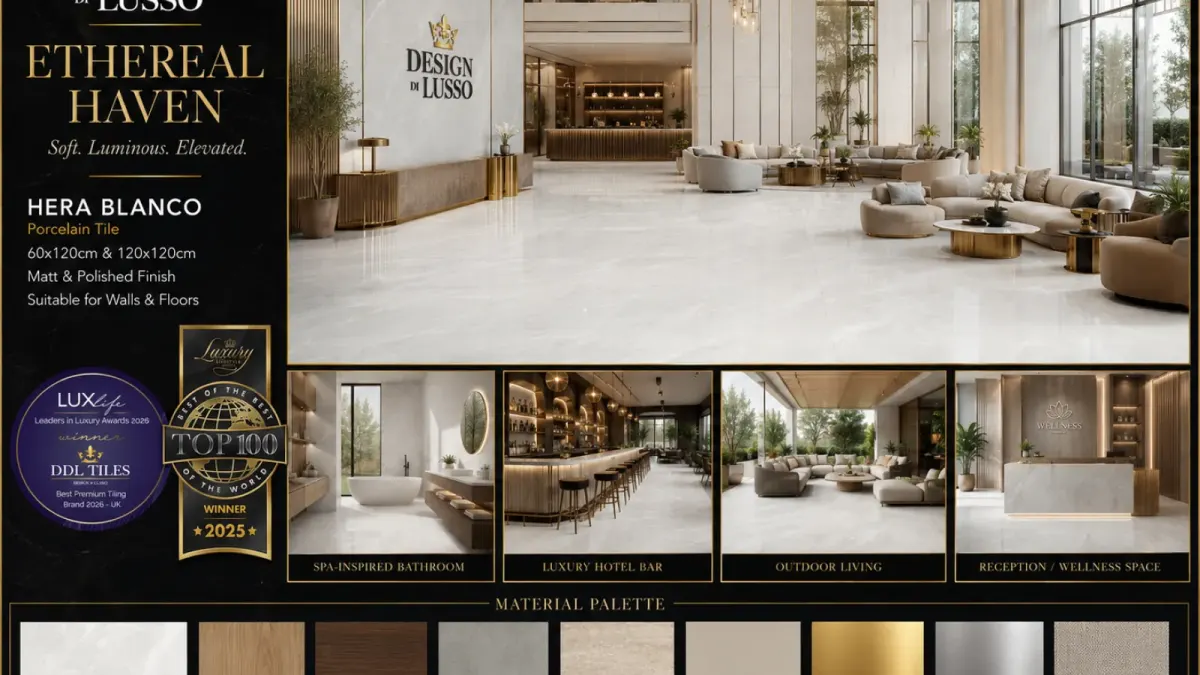
Effect-porcelain takes that performance and adds the look of a premium natural material, marble, stone, concrete or wood, using high-definition inkjet printing and, on premium ranges, rectified edges and vein-matching. You get the appearance of marble or stone with none of the sealing, etching or fragility. This is our specialism, and it is why we so rarely specify natural stone for a working bathroom.
Porcelain vs ceramic vs natural stone
It helps to know exactly what you're comparing, because the three behave very differently in a bathroom.
- Porcelain absorbs less than 0.5% water, is hard, dense, frost-proof and needs no sealing. Best all-round choice for every surface.
- Ceramic is softer and more porous (typically above 0.5%, often much higher). It is fine for dry walls but less suited to floors and wet areas, and lower-end ceramic chips more easily.
- Natural stone (marble, limestone, travertine) is beautiful but porous and calcium-based. It must be sealed on installation and re-sealed for life, etches with everyday acids like toothpaste and cleaning sprays, and is relatively soft, so it scratches and stains.
For the full technical breakdown, see our guide on the difference between porcelain and ceramic tiles. The short version: for a luxury bathroom that has to look beautiful and perform every day, effect-porcelain is almost always the right answer.
Thinking zone by zone: floor, wall, shower and feature
The defining habit of a designer is specifying each surface for its job, not treating the whole room as one. A bathroom has four distinct zones, and each has different demands.
- Floors need grip and durability. They take a slip-rated matt or textured finish and, ideally, a warm underfoot format over underfloor heating.
- Walls are all about look. Slip is irrelevant, so walls can carry polished, honed or gloss finishes that add depth, shine and light.
- Shower and wet areas need the highest slip safety and, on the shower floor, the most careful finish and format choice, plus stain-resistant grout.
- Feature areas, a wall behind the bath, a niche, a vanity backdrop, are where you spend your drama: a bolder marble, a polished finish, a statement format.
Here is how our team typically specifies each zone in a luxury bathroom:
| Bathroom zone | Best material | Finish | Format | Slip requirement |
|---|---|---|---|---|
| Main floor | Porcelain / effect-porcelain | Matt or textured | Large-format (600x1200mm) | R10+ |
| Shower floor | Porcelain | Textured / grip | Smaller format or mosaic for falls | R11 / PTV 36+ |
| Shower & wet walls | Porcelain / effect-porcelain | Polished or honed | Large-format | Not applicable |
| Main walls | Porcelain / effect-porcelain | Polished, honed or matt | Large-format | Not applicable |
| Feature wall | Effect-porcelain (marble/stone) | Polished for shine | Large-format, vein-matched | Not applicable |
Notice that the same marble or stone look can run through several zones in different finishes, which is exactly how you get a cohesive room where every surface still does its job.
Finish and slip: matt, honed, polished and staying safe
Finish is where looks and safety meet, and getting it wrong is the most common, and most dangerous, bathroom mistake. The rule is simple: match the finish to the surface.
The main finishes explained
- Matt has no shine, hides water spots and limescale well, and, in a textured version, gives grip. It is the default for floors and a calm, contemporary choice for walls.
- Honed is a smooth, low-sheen finish, softer than polished but more refined than matt. It reads elegant and tactile, and works beautifully on walls and feature areas.
- Polished is high-shine and reflective, bouncing light around a room and giving marble-effect its luminous depth. It is stunning on walls but too slippery for any wet floor.
For a fuller comparison of where each belongs, see our guide on matt vs polished tiles.
Understanding slip ratings
Slip safety is measured, not guessed, so specify by the numbers:
- R-rating (R9 to R13) measures slip resistance on an inclined ramp. For bathroom floors, look for R10 or above. For shower floors and wet rooms, step up to R11, or a rating designed for wet, barefoot use.
- PTV (Pendulum Test Value) is the UK's preferred measure. A PTV of 36 or above indicates a low slip risk in wet conditions and is the benchmark to ask for on wet floors.
A classic, elegant approach is to run a polished marble-effect on the walls for glow and a matt, slip-rated version of the same marble on the floor for grip. The look stays cohesive; the floor stays safe. Our team confirms slip ratings on every floor specification, especially for wet rooms and homes with children or older family members.
Size and format: why large-format tiles look more luxurious
If one specification choice separates a designer bathroom from an ordinary one, it is format, and the reason is grout lines. Fewer joints read as more luxury.
Large-format tiles (commonly 600x1200mm, 1200x2400mm and larger) make a bathroom feel bigger and calmer because they cover walls and floors with a fraction of the joints of standard tiles. Laid with thin, tonally matched grout, the surface reads as continuous slab rather than a grid of tiles. On effect-porcelain, that means marble or stone veining flows almost uninterrupted, and on vein-matched ranges it flows across the joints like a book-matched slab.
The benefits go beyond looks:
- A small bathroom feels larger. Fewer visible lines reduce visual clutter, so the room reads more spacious, a key trick covered in our guide on how to make a small bathroom look luxurious.
- Cleaning is easier. Fewer grout lines mean fewer places for limescale and grime to gather.
- The finish reads high-end. Continuous surfaces are what the eye associates with premium, hotel-standard bathrooms.
The trade-off is that large-format tiles are heavier, demand a properly prepared, flat substrate, and need experienced installation. This is not a surface to compromise the fitting on. Specify large-format from the start and plan for skilled installation, because the finished result is the entire point.
Colour and palette: choosing the mood
With material, finish and format settled, colour is where you set the emotional tone of the room. Each palette carries a distinct character, and the right one depends on the mood you want and the light you have.
- Marble looks (Calacatta, Carrara, grey marble, Nero Marquina) are the classic luxury choice, timeless, elegant and endlessly adaptable. See our marble-effect tiles for the full range of looks.
- Stone and concrete looks read calm, natural and contemporary, ideal for a spa-like, understated scheme.
- Wood-effect brings warmth and texture underfoot with none of timber's water worries, beautiful on floors and in Scandinavian or natural-luxury schemes.
- Green (sage, deep forest, verdigris) is the standout contemporary choice, rich and characterful, especially against brass brassware.
- Grey is the dependable modern neutral, from soft dove to moody charcoal, pairing with almost any brassware and joinery.
A reliable designer approach is to choose one calm palette for the bulk of the room, then one bolder look for a single feature. A soft Carrara or grey across the walls and floor, with a dramatic Calacatta or Nero feature wall behind the bath, reads far more considered than one busy tile everywhere.
Coordinating tiles with brassware and light
Palette choices don't sit in isolation. Warm marbles with gold veining sing against brushed brass; cool greys and Nero look sharp with chrome, steel or matt black; green pairs beautifully with brass or bronze. And always test your palette under your bathroom's real lighting, north-facing rooms cool a scheme down, warm downlights push it warmer, and a tile can look like a different colour on a full wall than it did on a sample.
How floor and wall tiles work together
One of the most common questions our showroom team hears is whether the floor and walls should match. The designer's answer: coordinate, don't clone.
Using the identical tile everywhere rarely gives the best result, because the floor and walls have different jobs. The floor needs slip resistance and durability; the walls want depth and light. The elegant solution is to use the same look in different finishes: a matt, slip-rated floor paired with a polished or honed wall version of the same marble or stone. The scheme reads cohesive and intentional, but each surface performs correctly.
Other proven pairings:
- Continuity for calm. A single stone or marble look, matt on the floor and honed on the walls, creates a continuous, spa-like envelope, especially powerful in a small room.
- Contrast for definition. A pale wall with a deeper floor grounds the room; a wood-effect floor warms a cool marble wall.
- A neutral base with one feature. Calm walls and floor, then one bold feature wall, is the most reliable route to a luxurious, considered scheme.
Whatever you choose, keep grout lines thin and tonally matched to the tile. That single detail, more than almost any other, is what separates a luxury finish from an ordinary one.
What luxury bathroom tiles cost
Pricing depends on range, size, finish and thickness, but it helps to think in bands rather than exact figures, and to remember that porcelain's low lifetime maintenance keeps its total cost of ownership down.
| Tier | Typical £ band (per m²) | What you get |
|---|---|---|
| Entry porcelain | £30-£60/m² | Standard formats, matt finishes, solid everyday porcelain |
| Premium effect-porcelain | £60-£120/m² | High-definition marble/stone/wood looks, larger formats, rectified edges |
| Designer & large-format | £120-£250+/m² | Very large formats, vein-matched marble, book-matched panels, premium ranges |
Two points our team always makes. First, effect-porcelain sits below natural marble both to buy and, more importantly, to live with, no sealing, no re-sealing, no etching repairs, no specialist care. Second, outlay properly for installation, especially with large-format tiles, which need a flat, well-prepared substrate and skilled fitting; the finished result is what you are paying for. For accurate, project-specific numbers, our design team can advise once we know your area, chosen range and format.
Common mistakes to avoid
Most bathroom regrets are predictable, and every one is avoidable with the right specification.
- Polished tiles on a wet floor. Beautiful on walls, dangerous underfoot when wet. Always specify a slip-rated matt or textured finish for any floor that gets wet.
- One busy pattern everywhere. A heavily veined marble across every surface of a small room feels overwhelming. Use a calm base and one bolder feature instead.
- Ignoring slip ratings. "It looked fine in the showroom" is not a safety standard. Specify R10+ on floors, R11 or PTV 36+ on wet floors.
- Thick, contrasting grout. Wide, mismatched grout lines turn continuous stone into an obvious tile grid. Keep grout thin and tonal, and use stain-resistant or epoxy grout in wet areas.
- Choosing from a small sample. Veining and colour read completely differently at full scale and under real lighting. See tiles large before you commit.
- Under-budgeting the installation. Large-format and rectified tiles demand skilled fitting. Cutting corners on the fit undoes the quality of the tile.
- Forgetting the whole scheme. Tiles have to work with brassware, joinery, lighting and the room's light. Specify them together, not in isolation.
Frequently asked questions
What are the best tiles for a bathroom?
Porcelain, and especially effect-porcelain, are the best all-round bathroom tiles. With a water absorption rate below 0.5%, porcelain is virtually non-porous, needs no sealing, and resists stains, scratches and etching. It suits every surface, from floors to shower walls, provided you match the finish to the location: slip-rated matt on floors, polished or honed on walls.
Should bathroom floor and wall tiles match?
Coordinate rather than clone. The best schemes use the same look in different finishes, a matt, slip-rated version on the floor and a polished or honed version on the walls, so the room feels cohesive while each surface performs correctly. Using the identical tile everywhere ignores that the floor needs grip and the walls want depth and light.
Are large-format tiles better for bathrooms?
Usually, yes. Large-format tiles (600x1200mm and larger) create fewer grout lines, so the surface reads as continuous slab rather than a grid, making a room feel bigger and more luxurious and easier to clean. They do need a flat, well-prepared substrate and skilled installation, so allow for professional fitting to get the finished result.
What slip rating do bathroom tiles need?
Bathroom floors should be R10 or above. Shower floors and wet rooms should step up to R11, or a PTV (Pendulum Test Value) of 36 or above, the UK benchmark for low slip risk on wet floors. Walls can use any finish, including polished, because slip is irrelevant on a vertical surface.
Is porcelain or ceramic better for bathrooms?
Porcelain is better for most bathroom uses. It absorbs less than 0.5% water, is denser, harder and frost-proof, and needs no sealing, making it ideal for floors and wet areas. Ceramic is softer and more porous, fine for dry walls but less suited to floors and showers. See our porcelain vs ceramic guide for the full comparison.
Do luxury bathroom tiles need sealing?
Effect-porcelain never needs sealing, because it is non-porous and the pattern sits under a fired, glazed surface. Only natural stone tiles need sealing, on installation and repeatedly for life. In a porcelain bathroom, the only element worth a stain-resistant or epoxy specification is the grout in wet areas.
What colour tiles work best in a bathroom?
There is no single best colour, it depends on the mood and light. Marble looks are timeless and adaptable; greys are the dependable modern neutral; wood-effect adds warmth; green is the standout contemporary choice; stone and concrete read calm and spa-like. A reliable approach is a calm base palette with one bolder feature look.
How much do luxury bathroom tiles cost?
Effect-porcelain typically ranges from around £60-£120/m², with designer, large-format and vein-matched ranges rising to £120-£250+/m². It sits below natural marble both to buy and, crucially, to live with, since porcelain needs no sealing, refinishing or specialist care. Entry separately for skilled installation, especially with large-format tiles.
Choosing your bathroom tiles with confidence
Choosing luxury bathroom tiles is really a sequence of layered decisions, material first, then zone by zone finish and slip, then format, then colour and how the surfaces work together. Get that order right and the result is a bathroom that looks effortlessly high-end and performs beautifully for decades. The common thread through every decision is effect-porcelain: the material that gives you the look of marble, stone or wood with the performance of porcelain. Specify thoughtfully, keep grout thin and tonal, match finish to surface, and see your tiles at full scale before you commit, and you will get a room you are still delighted with years later.
See luxury bathroom tiles in person at our Watford showroom
Tiles reveal themselves at full scale, under real lighting, in a way no sample or photograph can. Visit our 7,000 sq ft showroom in Watford to see our effect-porcelain collections laid out at scale, compare matt, honed and polished finishes side by side, and plan your bathroom with our award-winning design team. Whether you are a homeowner planning one statement bathroom or an architect specifying for a client across Hertfordshire and North West London, we will help you choose luxury bathroom tiles like a designer, and offer a free consultation to get you started.
Book your free consultation at our Watford showroom →
Design Di Lusso (DDL Tiles), Watford, Luxury Lifestyle Awards, Top 100 Best of the Best 2025. Explore our luxury bathroom design service and marble-effect tiles.